How to Stop Your Dog From Begging at the Table: A Training Plan That Works
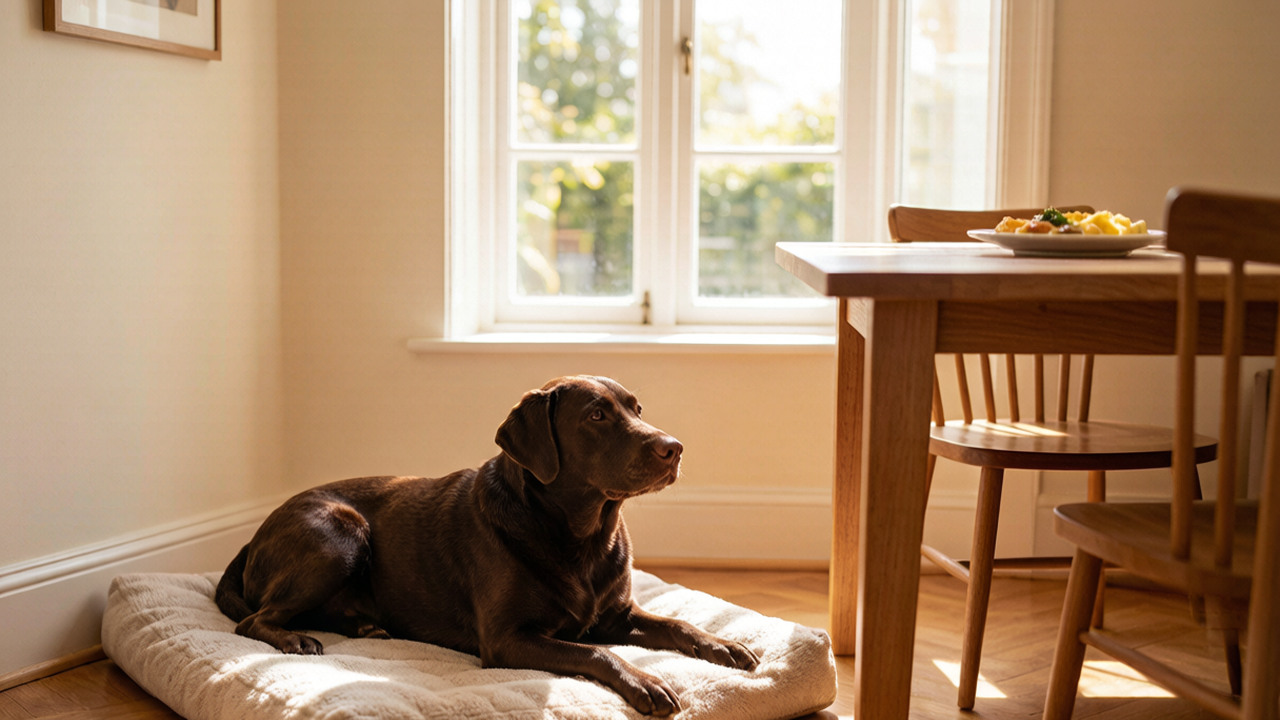
Begging at the table is one of the most common complaints from dog households. A food-motivated Labrador can turn every meal into a test of willpower: a chin resting on a knee, a paw on a thigh, a soft whine escalating to a louder one, and finally the full-body lean. There is no dignity in it — for either party.
Most households try the standard advice first, and much of it fails or backfires. The approach below explains why, and lays out a training plan that actually changes the behavior.
Begging is learned, not innate. The AKC notes that reinforcing a behavior — even occasionally — is what keeps it alive, which is why intermittent scraps are so effective at training the dog to persist [source].
Why "Just Ignore Him" Falls Short
The most common advice is to ignore the dog. It only works when the behavior has not already been reinforced for months. A dog with a long history of occasional scraps has learned that persistence pays — that if he tries long enough, the human eventually cracks. And in most households, the human does crack.
Ignoring a dog with two years of intermittent reinforcement is like trying to quit a habit while the trigger appears every few hours. The behavior is too deeply wired to fade on its own. The fix is to stop the reinforcement and teach a competing behavior, not to simply look away.
Common Missteps That Backfire
Several popular responses make begging worse rather than better:
A gentle shove for space. To a dog, a hand pushing him is interaction — attention that rewards the behavior and often makes him bounce back more excited.
A chew toy at mealtime. A dog motivated by table food will abandon the toy the moment he smells dinner. The toy is not the reward he wants.
Yelling "no." A sharp word startles for a few seconds, then the begging resumes. It teaches the dog nothing about what you do want, only that you are sometimes loud for unclear reasons.
Feeding his own dinner simultaneously. This helps briefly, but a dog finishes in under a minute while the human eats for twenty. That leaves most of the meal as uninterrupted begging time.
Banishing him to another room. No dog in the room means no begging — but a dog left alone may scratch and cry through the meal, trading one problem for another.
A Three-Part Training Plan That Works
Most households see major improvement within the first ten days and a durable change in about six weeks. The plan has three parts.
Step 1: Teach a Real "Place" Command
A reliable place command is the backbone of the fix. Start with the bed two feet away and no distractions. Say "place," lure the dog onto it with a treat, and reward the moment all four paws are on the bed. Repeat about twenty times, then release with a clear word (such as "free") and toss a treat away from the bed so the dog learns that leaving happens only on cue.
Next, build duration in tiny steps: reward while the dog is still on the bed after three seconds, then five, then ten. Take one step back, return, reward. Two steps. Then sit at the table, then pick up a fork. The difficulty rises so gradually the dog barely notices. The common error is rewarding after the dog leaves the bed, which teaches "go to bed, then get up." Pay for staying.
After two weeks of five-minute daily sessions, most dogs will stay on a bed in the dining-room corner for fifteen minutes or more while the household eats — because the bed now pays better than the table.
Step 2: End the Slip-Ups
No more table scraps — not a bite, not a lick of the plate. Intermittent reinforcement is the most powerful schedule there is; a single slip can undo a week of progress, the same mechanism that makes a slot machine compelling. The dog is not being stubborn; he is a rational animal responding to a variable-reward schedule the household accidentally built. A visible reminder on the fridge helps households stay consistent.
Step 3: Make the Mat the Best Spot in the Room
Rather than treating the bed as a "go away" zone — which a dog can read as punishment — make it the most rewarding place in the house. For two weeks, every time the dog chooses the mat, drop a high-value treat between his paws without a word. No command, no eye contact. Within days, most dogs choose the mat over the spot by your chair, because the mat pays and the table does not.
The AKC's training guidance supports rewarding an incompatible behavior — such as settling on a mat — to replace attention-seeking actions like begging [source].
What Mealtime Looks Like After Training
Once the plan is consistent, the dog walks to his bed without being told when the household sits down to eat. He settles, dozes, or watches with a calm expression that still holds a little hope but no pressure. A food-motivated Labrador does not stop being food-motivated — that is temperament, not a training failure. He simply learns that begging earns nothing while settling on the mat earns occasional rewards and a calmer home.
For households in the middle of this now: start with the mat. Spend a week making that one spot the most rewarding place in the house, with no strings attached. Layer in duration and distance later. The first goal is to make the dog want to be somewhere other than at your knee.
Frequently Asked Questions
How long does it take to stop begging?
Most homes see clear change within ten days and a lasting result in about six weeks, provided scrap-feeding stops completely.
Is it cruel to keep the dog out of the room?
Banishing him is less effective than teaching a settle on a mat within the room, which keeps him included without rewarding begging.
Will a chew toy fix it?
Only if the toy outranks the table food. For a food-driven dog, a mat paired with high-value treats works better than a toy alone.
🐾 Enjoyed This Article?
Save it for later, share with a fellow pet parent, or check out more tips on our homepage!
Shop dog puzzle feeder on Amazon & Chewy
Comparing prices before you buy? Check current deals and read reviews from other pet owners.