My Dog Destroyed a $1,200 Couch While I Was at the Grocery Store: What Finally Stopped the Destruction
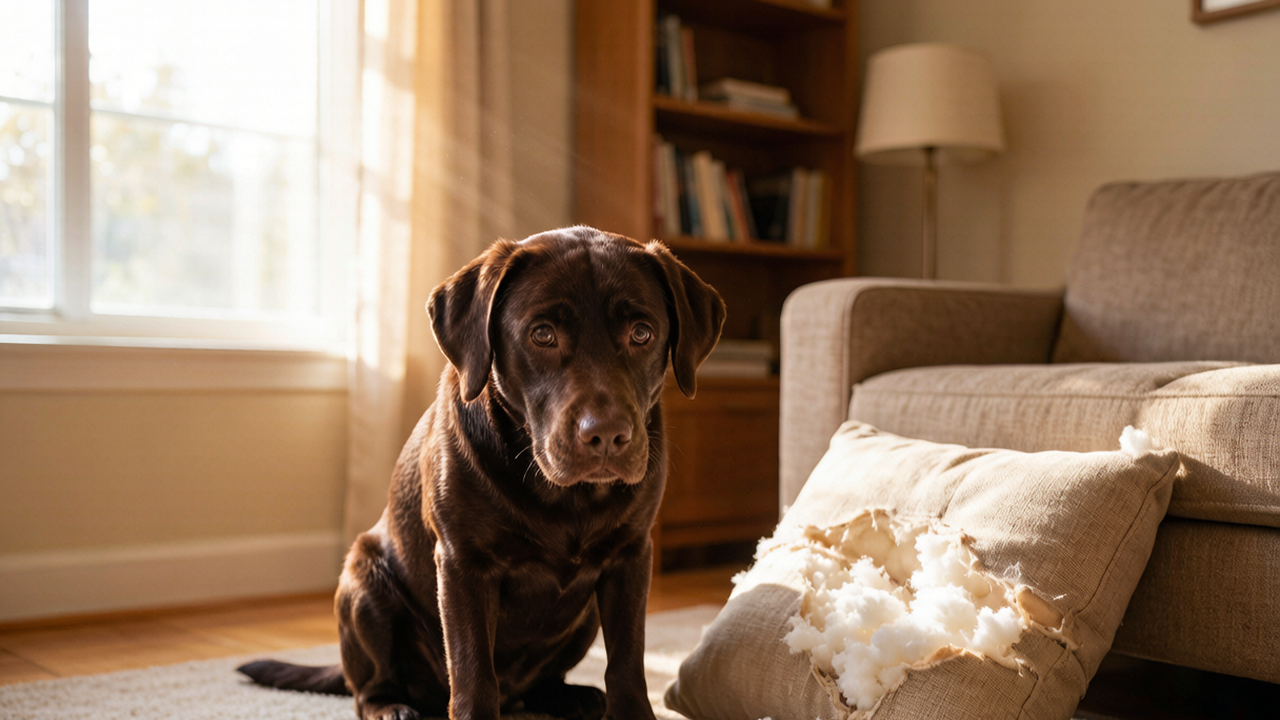
I walked through the front door with two bags of groceries and immediately knew something was wrong. The living room looked like it had been hit by a snowstorm — except the snow was beige upholstery foam. Cooper, my chocolate Lab, was lying in the middle of it all, tail wagging, with a piece of couch cushion still dangling from his mouth like he was proud of his interior design work.
I'd been gone 45 minutes.
That couch was brand new. Twelve hundred dollars. I'd had it for three weeks. And in less than an hour, my 80-pound dog had excavated a crater in the seat cushion deep enough to hide a small child in. I didn't yell — I couldn't. I just sat down on the one undamaged corner and stared at the foam confetti drifting across my floor.
That was the moment I realized this wasn't a puppy problem anymore. Cooper was four years old. This was something else entirely.
The "He'll Grow Out of It" Myth
Here's the thing about destructive chewing in adult dogs: everyone tells you it's a phase. When Cooper was a puppy, I'd come home to chewed baseboards, shredded magazines, and one memorable incident involving a library book I still haven't paid for. People said, "Oh, he'll grow out of it. Give him more toys."
So I bought more toys. Thirty-seven of them, at last count. Stuffed animals with squeakers. Rope bones. Rubber balls. Those fancy puzzle toys that cost more than my dinner. Cooper would destroy each one within a day and then go right back to whatever piece of furniture caught his eye.
The truth — and I learned this the hard way — is that adult dogs don't destroy things because they're teething. They destroy things because something is missing. Either they're bored out of their minds, they're anxious, or they've never been taught what's actually okay to chew and what isn't.
And a new chew toy every week doesn't fix any of those things.
Why Your Adult Dog Is Still Destroying Your House
After the couch incident, I finally called a trainer instead of just complaining to my friends. She asked me three questions that changed everything:
"How much actual exercise is he getting?"
I said, "We walk every day." She asked what that looked like. Our "walks" were 15 minutes around the block — a leisurely sniffing tour, not exercise. For a Labrador retriever bred to retrieve ducks from freezing water for eight hours straight, that's basically a warm-up lap.
"What does he do while you're gone?"
I admitted the truth: nothing. Cooper had access to the entire downstairs while I was at work. Eight hours with nothing to do but stare at walls and wait for the mailman. That's not a dog living his best life — that's a dog serving a silent sentence of boredom.
"Is this happening only when you leave, or anytime?"
I thought about it. The worst destruction — the couch, the door frame, the remote control — always happened when I was gone. But there was also the occasional shoe-chewing while I was watching TV in the next room. Two patterns. Two different problems.
What I Tried First (and Why It Didn't Work)
Before I actually understood what was going on, I tried every quick fix the internet suggested:
Bitter apple spray. Cooper licked it off the couch leg once, made a face, and then chewed a different spot. The bottle lasted three days before I gave up.
Scolding him after the fact. I'd come home, see the damage, and drag him over to the evidence with my best disappointed-dad voice. Cooper would look guilty — ears back, whale eyes, tail tucked — but that wasn't guilt. That was appeasement. He had no idea what I was upset about. He just knew I was upset, and that made him anxious. Which, as you can probably guess, made the chewing worse the next time I left.
Getting more toys. I already mentioned the 37 toys. What I didn't realize is that a dog who has access to the same toys every day gets bored of them just like we get bored of the same Netflix show on repeat. They stop being interesting. The couch leg, on the other hand, is always interesting — it smells like you, it has a satisfying texture, and destroying it makes a really fun mess.
Crating him without preparation. I bought a crate, put Cooper in it, and left for work. Came home to a dog who'd bent the door, cut his nose, and was panting so hard I thought he'd have a heart attack. That's when I learned the difference between a dog who's comfortable in a crate and a dog who's panicking in one.
What Actually Worked: The Four Things That Saved My Furniture
It took about three months of consistent effort, but I got Cooper from couch-destroyer to trustworthy house dog. Here's what actually moved the needle:
1. Real Exercise, Not "Walks"
The trainer told me a phrase I'll never forget: "A tired dog is a good dog, but a well-exercised dog is a great dog." She wasn't talking about longer walks — she was talking about activities that actually raised Cooper's heart rate and engaged his brain.
I started doing 30 minutes of fetch in the morning before work — actual running, not lazy tosses. In the evening, we'd do another 20 minutes of off-leash time at the park, plus 10 minutes of tug or training. The difference was immediate. Cooper went from bouncing off the walls to actually settling on his bed. He'd sleep while I was gone instead of searching for something to destroy.
The math is pretty simple: a Labrador's daily energy requirement isn't met by a 15-minute stroll. Most medium-to-large breeds need 45 to 90 minutes of real activity. Not all at once — broken into two or three sessions works better — but it has to be actual exercise, not just sniffing the neighbor's mailbox.
2. Mental Stimulation That Actually Tires Them Out
Here's something I wish someone had told me years ago: 15 minutes of mental work tires a dog out faster than 30 minutes of physical exercise. Think about how exhausted you feel after a difficult exam or a stressful meeting — your dog's brain works the same way.
I started feeding Cooper every meal through puzzle toys instead of a bowl. A Kong Wobbler for breakfast. A snuffle mat for dinner. Sometimes I'd just scatter his kibble across the kitchen floor and let him hunt for every piece. What used to take 90 seconds to inhale now took 20 minutes of focused work.
Frozen Kongs became my secret weapon. I'd stuff them with wet food or peanut butter (the kind without xylitol — check your labels, seriously), freeze them overnight, and give one to Cooper right before I left. He'd spend 45 minutes working on it, and by the time he was done, he'd be too tired to care about the furniture.
3. Restricting Access Until He Earned Trust
This was the hardest one for me emotionally. I hated the idea of "locking him up." But the trainer explained it like this: you're not punishing him — you're setting him up to succeed. If he doesn't have access to the couch, he can't destroy the couch. And every day he doesn't destroy anything is a day he practices being good.
I started with a baby gate that kept Cooper in the kitchen while I was gone — tile floors, nothing to chew but his toys and his bed. After two weeks of zero incidents, I gave him the kitchen plus the hallway. Two more weeks, the living room. It took about two months before he had full house privileges again, but by then, he'd built a habit of leaving furniture alone.
The key was making his confined area actually nice. His bed was there. His water. A frozen Kong. A bully stick. The idea isn't jail — it's a dog-proofed den where he feels safe and has appropriate things to do.
4. Treating the Anxiety, Not Just the Chewing
For Cooper, the destruction when I left wasn't just boredom — there was an anxiety component too. I could tell because he'd start pacing and whining when he saw me put on shoes. The chewing near doors and windows was a dead giveaway.
I started doing departure practice — putting on shoes, grabbing keys, walking out the door, and coming back in 30 seconds. Then a minute. Then five minutes. Then fifteen. Over and over until Cooper stopped caring whether I left or not, because he'd learned I always came back. This is called desensitization, and it's tedious as hell, but it works.
I also stopped making a big deal out of departures and arrivals. No long goodbyes, no excited reunions. Just walk out like it's nothing, walk in like it's nothing. The drama was feeding his anxiety.
How to Tell If It's Boredom or Anxiety
This distinction matters because the fix is different for each:
Boredom chewing usually happens anytime, anywhere — not just when you're gone. The dog might chew a shoe while you're in the next room. The damage is often spread across different items, and the dog seems generally relaxed otherwise.
Anxiety chewing typically happens only (or mostly) when you leave. It's often focused on exit points — door frames, window sills, the front door itself. You might also see pacing, drooling, barking, or potty accidents. If your dog starts getting worked up before you even walk out the door, anxiety is probably the main driver.
Some dogs, like Cooper, have both. That's when you need to address exercise and enrichment (for the boredom) plus the departure training (for the anxiety).
The Bottom Line
It's been eight months since the couch incident. I still have the same furniture — all of it, undamaged. Cooper still gets his frozen Kong every morning, still runs himself tired at the park, still eats dinner out of a puzzle toy. It's more work than just filling a bowl and hoping for the best, but it's a hell of a lot cheaper than replacing furniture.
The thing I wish I'd understood sooner is that destructive chewing isn't your dog being bad or spiteful. Your dog doesn't look at your new couch and think, "I'm going to ruin this because I'm mad she left." Your dog thinks, "I am so bored/anxious/stressed right now, and chewing this thing makes me feel better." Once you understand that, the solution isn't about punishment — it's about figuring out what need isn't being met.
If your dog is destroying your house, ask yourself: when's the last time they were genuinely tired? When's the last time their brain got a real workout? And do they actually feel safe when you're gone?
Fix those things first. The furniture will probably survive.
---
What's the most expensive thing your dog has ever destroyed? Drop it in the comments — I need to know I'm not the only one who's cried over a couch cushion.
🐾 Enjoyed This Article?
Save it for later, share with a fellow pet parent, or check out more tips on our homepage!