Your Dog Destroyed the House While You Were Out — and It Wasn't a Burglar
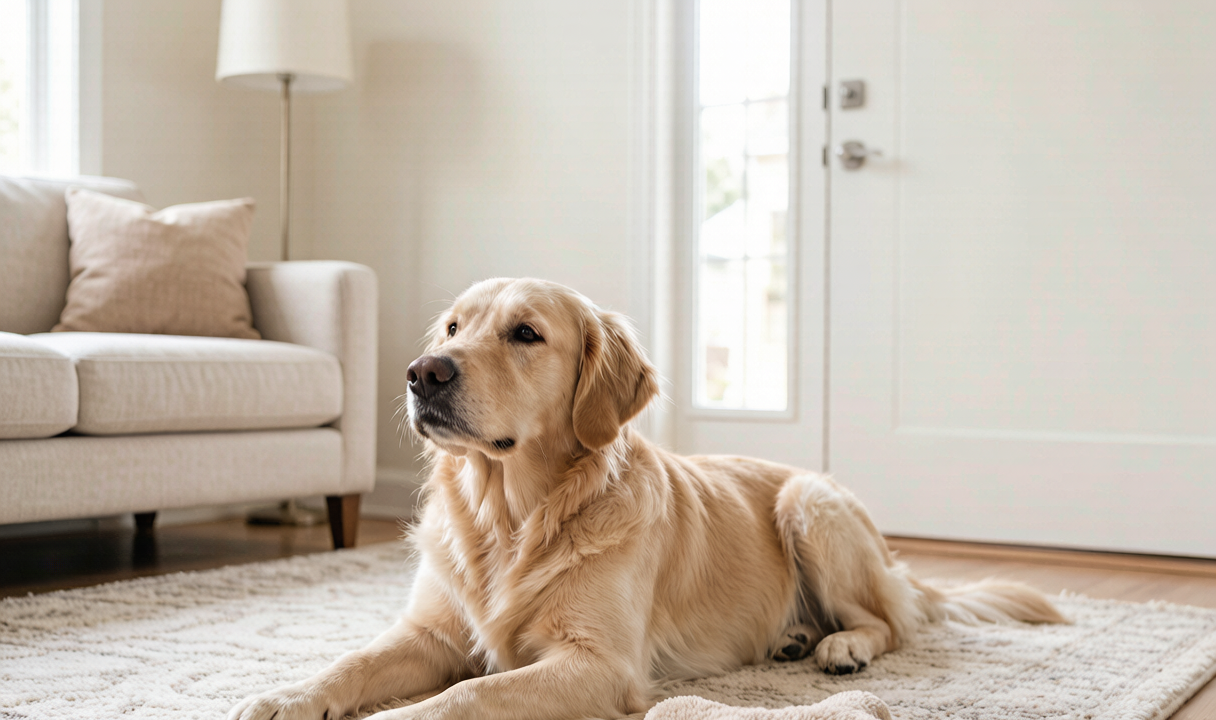
Coming home to that kind of damage is disorienting. A gutted couch cushion, stuffing across the floor, blinds bent at a 45-degree angle, and a dog-sized hole punched through the drywall beside the front door. The first assumption is usually a break-in. It almost never is.
The dog is usually sitting in the middle of the wreckage, panting hard, paws raw from digging at a door or a crate. This is not a dog who had a fun afternoon unsupervised. This is a dog who spent hours in genuine panic.
The difference between a bored dog and a dog having a full-blown panic attack is the single most important distinction in this entire topic. The aftermath can look identical. The two problems are not the same, and they do not have the same fix.
If you're reading this, you probably already know which one you're dealing with. The shredded pillows. The neighbors texting about nonstop barking. That sinking feeling in your stomach every time you grab your car keys.
Here's how to tell the two apart — and what actually works on the real thing.
What Separation Anxiety Actually Looks Like (Not What Instagram Tells You)
Here's what usually gets missed: a lot of what gets labelled "separation anxiety" is just a dog who is bored or under-exercised. Real separation anxiety is different — it's a panic disorder. Your dog isn't being spiteful. Your dog is terrified.
The telltale signs to look for:
- The destruction starts within minutes of you leaving, not hours later
- Your dog refuses food while alone — set up a camera and a Kong stuffed with peanut butter will often sit completely untouched
- Heavy drooling and panting that continues for the entire absence
- Shadowing you from room to room when you are home, bathroom included
- Trembling or pacing the moment you pick up your keys
If your dog checks three or more of those boxes, congratulations — you're not dealing with a bored chewer. You're dealing with a dog who genuinely believes you're never coming back.
Figures commonly cited in the veterinary behavior literature put separation-related problems at roughly 14% of dogs. The true number is likely higher, because a great many owners never raise it with a vet at all — they simply conclude the dog is badly behaved.
Four Common Responses That Make It Worse
These are the approaches most owners reach for first, and all four tend to backfire:
The "tough love" approach. The logic is that ignoring your dog and issuing firm corrections when they follow you will build independence. In practice it does the opposite. An already-anxious dog reads the withdrawal as confirmation that something is wrong, and shadows you even more closely than before.
Crating as punishment. Crating an anxious dog after a destructive episode is common advice and a genuinely bad idea. A dog in real panic will fight the crate, and bent doors, torn nails, and bleeding gums are typical results. You end up with a dog who is now terrified of the crate on top of everything else, and that association can take months to undo.
Getting a second dog. "He's lonely" is the usual reasoning, and it rarely holds up. Separation anxiety isn't about being alone — it's about being separated from you specifically. Most dogs with a true separation problem ignore a new housemate entirely and stay exactly as anxious as before, and now you have two dogs.
The "just tire them out" strategy. An hour of hard exercise before work leaves your dog flat out on their bed — right up until the keys come off the hook, at which point they are up, panting, and in full panic mode. Exercise is good for a bored dog. It does not treat a panic disorder.
If you've tried some of these, you're in good company — they're the default advice almost everyone gets. The point is simply to stop and switch to the approach that has evidence behind it.
What Actually Moved the Needle
This is the part that matters. What follows is the standard protocol veterinary behaviorists use, in the order it should be applied:
1. Desensitization: The 30-Second Rule
This sounds counterintuitive, but it is the core of the whole method. The goal is to teach your dog that departures are boring and temporary — not terrifying and permanent.
Start by walking to the door. Don't open it. Just walk there, touch the handle, then sit back down. Do this 20 times over a couple days until your dog stops reacting.
Then open the door, step out for one second, come back in. Do this 30 times.
Then five seconds. Then ten. Then thirty.
Expect the starting threshold to be low. In a severe case it may be three seconds before the panting starts — so three seconds is where you begin. Three seconds out, three seconds back in, repeated until it's completely uneventful.
Stepping in and out of your own front door forty times a day feels absurd, and it is also the thing that works. A realistic trajectory for a severe case looks like this: thirty seconds by the end of week two, five minutes by the end of the first month, a full grocery run by month three.
The rule is simple: never push past your dog's threshold. If they start showing anxiety signs (panting, whining, pacing), you went too long. Back up. This is not a race.
2. The Departure Routine Detox
Dogs are pattern-recognition machines. Yours has learned that "keys jingling + shoes going on + jacket zipping" reliably predicts being left behind.
So break the pattern. Jingle your keys, then sit down and watch TV. Put your shoes on, then make coffee. Pick up your jacket, then hang it back up. Do it a dozen times a day, in no fixed order, until none of it predicts anything.
By the time you actually leave, the departure cues carry no information, and your dog stops treating them as a warning.
This is usually the fastest-acting piece of the whole protocol. Many dogs stop reacting to the sound of keys within a week.
3. The Frozen Kong That Changed Everything
This one's simple but weirdly powerful: a Kong stuffed with wet food, sealed with peanut butter, frozen solid overnight.
Here's why it works: the act of licking releases endorphins in dogs. It's self-soothing behavior. And a frozen Kong takes 20-40 minutes to work through — which covers the critical window right after you leave, when anxiety peaks.
The key is that the Kong ONLY appears when you leave. It's not a random treat. It's a departure-specific signal that says "the human leaving means I get the best thing in the world."
This is called counter-conditioning — you're changing the emotional response from "leaving = terror" to "leaving = jackpot."
4. Medication: Not an Admission of Failure
Plenty of owners resist medication because it feels like giving up. That belief is common, and it costs dogs months of avoidable distress.
Fluoxetine (generic Prozac) is one of the medications vets commonly prescribe for severe cases. It takes roughly four to six weeks to reach full effect, and it does not "fix" the dog on its own. What it does is pull baseline anxiety down far enough that the training can actually land.
Think of it like this: if your dog is at a 9/10 panic level when you leave, desensitization training is nearly impossible — there is no calm baseline to build on. Medication can bring that down to a 5 or 6. Still anxious, but reachable. Trainable.
If your dog is injuring themselves — raw paws, torn nails, bleeding gums from trying to escape a crate — talk to your vet about medication. That isn't giving up. It's giving the training a chance to work.
5. A Pet Camera, So You Stop Guessing
A basic indoor camera costs around $30 and it's the highest-value purchase on this list.
Skip the two-way audio. Hearing your voice with no body attached tends to confuse an anxious dog rather than settle them. The value is in the footage. Most owners find their dog isn't panicking for four straight hours: distress peaks in roughly the first fifteen minutes, then drops back to restless pacing and occasional whining. There's no other way to see that pattern, and no other way to measure whether the training is working.
It also gives you a concrete benchmark. Pacing within ten seconds of the door closing in week one, then settling down with a Kong by week six, is what real progress looks like on camera.
Two Things Worth Doing From Day One
The first: start small, and don't be embarrassed by how small.
Three-second departures feel pointless. Walking in and out of your own door forty times feels ridiculous. But if three seconds is your dog's actual threshold, starting anywhere above it sets the whole process back.
The second: tell your neighbors what's going on. A dog in the worst phase of separation anxiety barks, and a short note explaining the situation and the plan you're following buys a surprising amount of goodwill. It's far better than letting a neighbor quietly accumulate resentment until they file a complaint.
Is Your Dog Actually Anxious or Just Bored?
One last thing, because this distinction changes everything:
A bored dog chews your shoes at hour three. An anxious dog destroys the door frame at minute three.
A bored dog eventually settles down and naps. An anxious dog never settles — the camera footage shows constant movement, panting, drooling, for hours.
A bored dog will eat treats you leave. An anxious dog is too panicked to eat anything.
If it's boredom, the fix is exercise and mental stimulation. If it's anxiety, the fix is desensitization training (and possibly medication).
Both are fixable. Neither makes you a bad owner.
Set expectations accordingly. Most dogs never learn to love being left alone. What changes is the intensity — from destroying drywall to settling on the couch with a Kong. For a severe case, that shift typically takes around four months of consistent work.
If your dog is showing the severe signs described above — self-injury, refusing all food while alone, hours of unbroken distress — bring in your vet or a veterinary behaviorist before you start. Separation anxiety is very treatable, but the more severe the case, the less it responds to training on its own.
Shop dog separation anxiety calming on Amazon & Chewy
Comparing prices before you buy? Check current deals and read reviews from other pet owners.