My Dog's Barking at the Doorbell Was So Bad, the UPS Guy Started Leaving Packages at the End of the Driveway
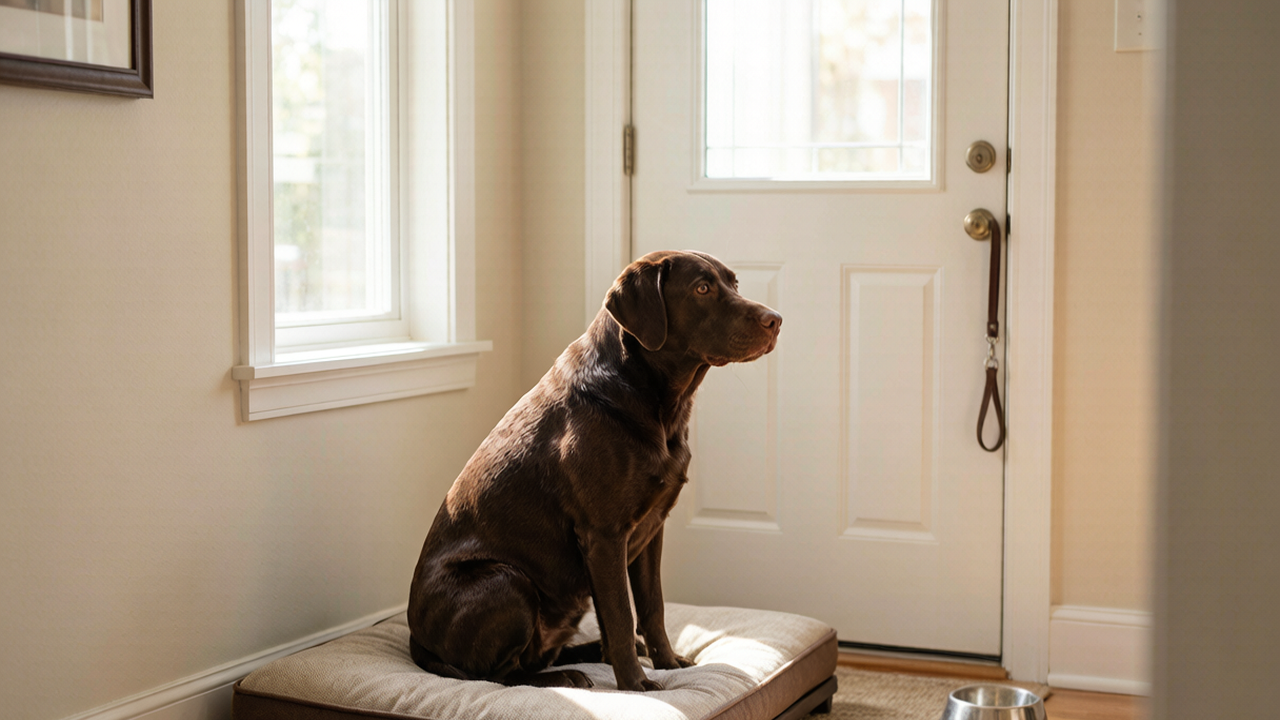
I knew we had a problem when our regular delivery driver — a guy named Mike who'd been on our route for three years — stopped ringing the bell altogether. He'd leave boxes at the edge of the driveway, rain or shine, with a Post-it note that just said "Dog." No hard feelings, honestly. Cooper, my chocolate Lab, sounded like he was trying to tear a hole through the front door every time someone dared to set foot on our porch.
The breaking point was my mother-in-law's birthday dinner. Six guests arrived over the course of twenty minutes. Cooper hit a decibel level I didn't know a dog could reach, knocked over a floor lamp while body-slamming the door, and barked so hard he gave himself a coughing fit that lasted ten minutes. My wife looked at me across the chaos and said the four words every dog owner dreads: "We need to fix this."
That was about a year and a half ago. Cooper still barks at the doorbell sometimes — he's a dog, not a robot — but we went from "the neighbors have definitely talked about us" to "people can actually visit our home without earplugs." Here's everything I tried, what failed, and what finally worked.
Why Dogs Lose Their Minds at the Doorbell (It's Actually Not Their Fault)
Before I get into the fix, let me explain what's happening in your dog's brain when that bell rings, because understanding this changed how I approached the whole thing.
A doorbell is basically the perfect storm of dog triggers. It's sudden, it's loud, it's unpredictable, and it reliably predicts one of the most exciting or threatening things in a dog's world: a stranger at the boundary of their territory. When Cooper heard that ding-dong, his brain wasn't thinking "oh, a friend is here." It was thinking "INTRUDER. ALERT. ALERT. ALERT."
Here's the part that made me feel like an idiot: I had been accidentally rewarding this behavior for months. Every time Cooper barked at the door, I'd rush over, grab his collar, and hiss "Cooper, quiet!" In dog language, I was basically joining the bark party. My rushing, my grabbing, my excited voice — it all confirmed what Cooper already believed: the doorbell means SOMETHING BIG IS HAPPENING and we should all be VERY CONCERNED ABOUT IT.
A trainer I eventually worked with put it bluntly: "Your dog thinks you're his backup vocalist."
What I Tried That Made It Worse
I'm sharing my failures because you've probably tried (or been tempted to try) the same things.
Yelling "NO" or "QUIET." This worked exactly zero times. Cooper just barked louder, presumably thinking I was enthusiastically agreeing with him about the threat. Volume matching a barking dog is like trying to put out a fire with lighter fluid.
The spray bottle. We lasted two days with this. Cooper learned to associate the water bottle with me, not with the doorbell. He'd bark, see me reach for the bottle, and sprint to the other side of the room — still barking. Then he'd shake water everywhere and give me a look that clearly said "you've betrayed our friendship." It didn't stop the barking. It just made him bark from further away.
Holding his muzzle shut. I cringe typing this. A "friend" recommended it. Cooper thrashed his head and looked genuinely scared. It damaged his trust in me for weeks, and it accomplished absolutely nothing except making me feel like a terrible person. Don't do this. Ever.
Putting him in another room. This didn't solve anything; it just relocated the problem. Cooper would bark from the bedroom while I answered the door, then burst out the moment I opened the bedroom door again, extra worked up. We hadn't taught him anything — we'd just delayed the explosion.
What Actually Worked (The Four-Part System)
After burning through those failures, I found a trainer who specialized in door-related reactivity. She didn't just give me one trick — she gave me a system. Four interconnected pieces that, when used together, actually rewired Cooper's response to the doorbell.
Part 1: The "Place" Command — But Not How Most People Teach It
You've probably heard of teaching your dog to go to a "place" or mat when the doorbell rings. What most tutorials skip is that this only works if the place has genuine value to your dog. It can't just be a bed you point at — it has to be somewhere your dog genuinely wants to be.
I spent two weeks building Cooper's place as a reward magnet before I ever paired it with the doorbell. I bought a $25 raised cot bed and put it in the corner of the living room, about fifteen feet from the front door. Every single day, multiple times a day, I'd do "magic mat" sessions: I'd walk near the mat and drop a high-value treat on it without saying anything. Cooper quickly learned that this mat spontaneously generated chicken.
Within four days, he was sprinting to that mat whenever I walked toward it. Once that was solid, I added the verbal cue "go to your spot" — said in a calm, matter-of-fact voice, never yelled. Chicken appeared every single time he went there and parked himself.
The key detail: I never forced him onto the mat. I never dragged him there by the collar. The mat had to be a place he chose voluntarily, or the whole thing would crumble the moment the doorbell rang and his brain flooded with adrenaline.
Part 2: Desensitizing the Doorbell Sound (Starting at Basically Silent)
Here's where most people mess up: they try to train with the real doorbell at full volume while their dog is already in full meltdown mode. That's like trying to teach someone calculus while they're being chased by a bear. Zero learning happens.
I recorded our actual doorbell sound on my phone. Then I played it at the lowest possible volume — so low I could barely hear it myself. I'd play the sound, toss a piece of chicken onto Cooper's mat, and repeat. Ten reps, twice a day.
After three days at that barely-audible level, I bumped the volume up one notch on my phone. Cooper's ears twitched but he stayed on the mat. More chicken. Another three days. Another volume notch.
It took almost three weeks of daily five-minute sessions to get to full volume, but by the end of it, Cooper associated the doorbell sound with "go to your mat and receive chicken" instead of "sound the alarm and prepare for battle." The emotional response had shifted. That's the actual goal — not teaching a trick, but changing how he felt about the sound.
Part 3: The Greeting Protocol (This Is Where Most Dogs Backslide)
Having Cooper on his mat while the doorbell rang was step one. But the moment I actually opened the door and a real person walked in, all that training evaporated. The sight of a visitor was a stronger trigger than the sound.
I recruited three friends (bribed them with pizza) for structured practice sessions. The protocol:
- Friend texts me when they're outside. No doorbell yet — we'd built that skill separately.
- I cue Cooper to his mat and feed him a continuous stream of tiny treats.
- I open the door just a crack. If Cooper stays on the mat, chicken keeps flowing.
- I open the door wider. Friend stays outside. More chicken.
- Friend steps inside but doesn't look at or acknowledge Cooper. This is crucial — eye contact from a stranger amps up a dog's arousal instantly.
- Friend sits down. Once Cooper is calm (this took three to five minutes the first few times), I release him from his mat and he can greet the person.
The first practice session was messy. Cooper broke his stay three times when my friend Mike stepped through the door. Each time, Mike immediately turned his back and I quietly walked Cooper back to his mat — no scolding, no frustration, just a calm reset. By the fourth practice session, Cooper stayed on his mat the entire time. By the eighth, he barely lifted his head when Mike walked in.
Part 4: The Management Backup (For When Training Isn't Enough)
I'd love to tell you the training solved everything permanently. It didn't. There are still moments — a loud knock from a delivery person, a group of six people arriving at once, the doorbell ringing during a thunderstorm — where Cooper's training brain gets hijacked by his dog brain.
For those moments, I keep a leash hanging by the front door. If I can see Cooper's about to lose it, I clip the leash on before opening the door. This isn't punishment. It's management. It prevents him from rehearsing the barking behavior, which is the number one thing that causes backsliding.
I also bought a cheap wireless doorbell on Amazon for $18 and set it to a completely different chime — a pleasant two-note tone instead of our aggressive "DING-DONG." Changing the sound itself removed a layer of learned association. Cooper had years of bark-rehearsal connected to that original chime. The new sound came without that baggage.
The Timeline Nobody Talks About
Trainers on YouTube make this look like it takes two sessions and a bag of treats. That was not my experience.
- Week 1-2: Mat = chicken factory. Doorbell desensitization at low volume.
- Week 3-4: Mat + mid-volume doorbell. Still no real visitors.
- Week 5-6: First practice sessions with friends. Messy but progress.
- Week 7-8: Real visitors (the in-laws came over — ultimate test). Cooper barked twice, caught himself, and trotted to his mat. I almost cried.
- Month 3-6: Consistent improvement with occasional regressions during high-stress situations.
We're now over a year in. Cooper has one alert bark when the doorbell rings — a single "woof" — and then he goes to his mat. That single bark is actually perfect; I want to know someone's at the door. What I don't want is the seventeen-bark, lamp-breaking, neighbor-complaint-generating performance we used to have.
What I'd Do Differently If I Started Over
- I wouldn't have yelled. It confused him and made everything worse.
- I'd have bought the different-sounding doorbell on day one instead of month four.
- I'd have recruited friends for practice sessions way earlier instead of trying to train during real deliveries.
- I'd have accepted earlier that this takes months, not days, and stopped beating myself up about slow progress.
If your dog barks at the doorbell, I promise you're not failing. You're fighting against millions of years of territorial instinct with chicken and a bathmat. It works — it just takes longer than anyone wants to admit.
Now I want to hear from you: what's the doorbell situation at your house? Are you in the "delivery driver leaves notes" phase, or have you found something that works? Drop a comment — I read every single one, and honestly, I need to know I'm not the only one whose dog once barked so hard he gave himself a coughing fit.
🐾 Enjoyed This Article?
Save it for later, share with a fellow pet parent, or check out more tips on our homepage!