Why Does My Cat Go Crazy at Night? 3 AM Zoomies Explained
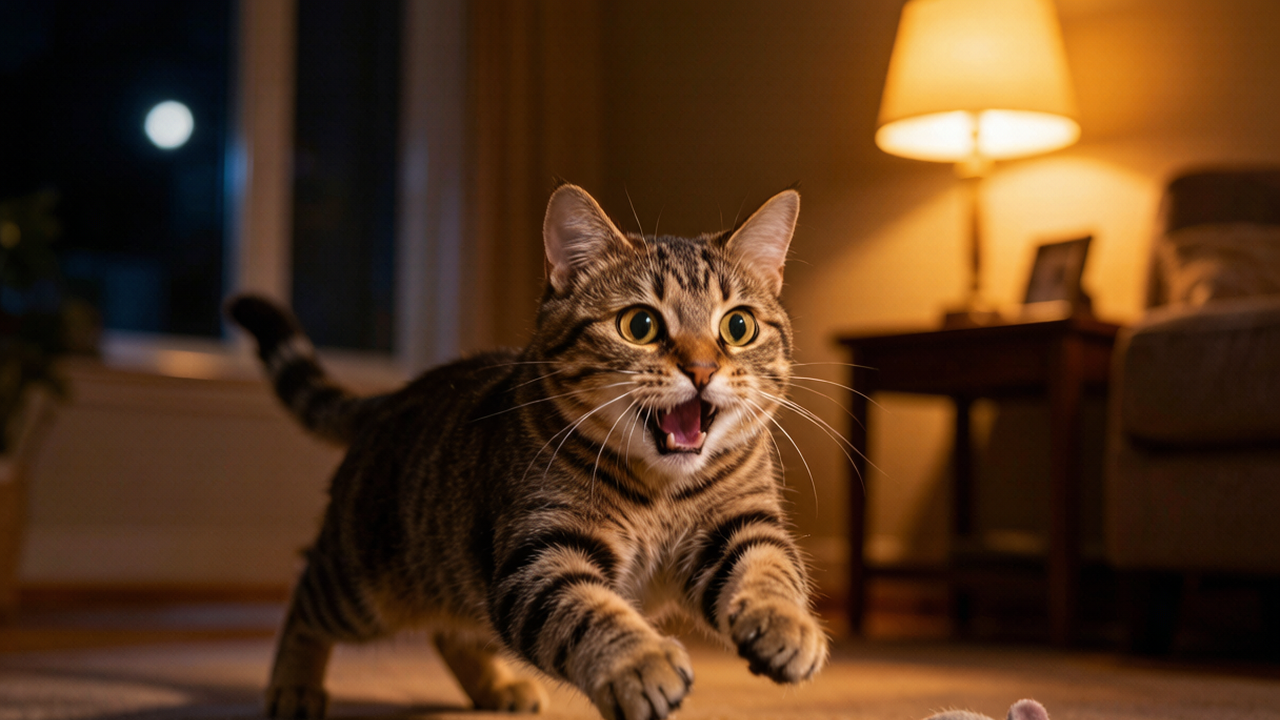
The first time it happens, it sounds like a break-in. 3:17 AM. Loud thumping, something crashing, what sounds like a small animal being murdered in the hallway. You grab your phone, creep out of bed with your heart pounding — and find an eight-pound cat doing parkour off the walls. Literally.
She launches off the couch, ricochets off the hallway wall, slides across the hardwood into a stack of magazines, then shoots back the other direction like she's being chased by an invisible fire. Pupils the size of dinner plates the entire time.
Night one, it's funny. By night five, it isn't. You're sleep-deprived, cranky, and starting to wonder whether something is genuinely wrong with your cat.
Usually nothing is. What's wrong is the daily routine wrapped around her. Once you understand what's driving the 3 AM chaos, the fix is surprisingly simple — not overnight, but over roughly a week, most cats go from "every single night" to "maybe once a month."
Here's what's actually happening, what works, and what makes it worse.
The "Why" That Nobody Explains
Cats aren't being jerks when they go berserk at 3 AM. They're being… cats. Specifically, they're being crepuscular predators stuck in a modern human's schedule.
Crepuscular means their natural activity peaks are at dawn and dusk — prime hunting time for their wild ancestors. Those twilight hours are when prey animals are most active, so cats evolved to be wired for action right when we're trying to sleep or just waking up.
The problem isn't that your cat is nocturnal. It's that their crepuscular wiring lines up perfectly with 4-6 AM, and most of us aren't interested in playing "chase the feather" at that hour.
Here's what makes it worse:
Pent-up energy with no outlet. You go to work. The cat sleeps. You come home tired. The cat has been charging their battery for eight hours. By 3 AM, they're at 100% and there's nothing to hunt except your feet under the blanket.
The "reward loop" you don't realize you're in. This is the mistake almost every household makes. At 3 AM your cat knocks something off the nightstand. You groggily shoo her away — or worse, get up and feed her to buy some quiet. What that teaches her is simple: "Make noise at 3 AM → the human interacts with me → sometimes there's even food." Night after night, you're training the exact behavior you want to stop.
Hunger timing that works against you. Cats in the wild hunt, eat, groom, sleep. In that order. When we free-feed or do one big dinner at 6 PM, by 3 AM they've been fasting for 9 hours. Their body is saying "hunt now." Their environment is saying "everything is boring and the human won't get up."
Boredom is the accelerator. A cat in a bare apartment with no climbing spaces, no window perches, no toys accessible at night — that cat is going to make their own entertainment. And cat-made entertainment at 3 AM usually involves your bookshelf, your curtains, and your sleeping face.
The "Fixes" That Make Everything Worse
Before the routine changes below, it's worth knowing which popular solutions backfire:
The "tire them out before bed" mistake. Coming home at 10 PM and running an intense 20-minute laser pointer session feels like the obvious answer. It isn't. All it does is spike your cat's adrenaline right before your bedtime — she crashes for maybe 45 minutes, then wakes up more wired than before. It's the feline version of a HIIT workout at midnight, which doesn't produce sleep in humans either. A laser also gives her nothing to physically catch, so the hunt never resolves.
Locking her out of the bedroom. Shut the door and the yowling starts, and it can run for hours. Plenty of cats also learn to rattle the door by sliding a paw underneath it. It's a losing battle against an animal with infinite patience and no job to get to in the morning. A closed door can be part of the answer later — but only once the energy problem is solved.
Spray bottles. Skip this one entirely. It makes your cat afraid of you without stopping the behavior; she'll simply wait until you're out of spraying range. Cats don't connect punishment to the behavior, they connect it to the person delivering it.
Getting a second cat. The advice sounds reasonable: "get her a friend and they'll play with each other instead of waking you up." In practice, two cats with pent-up energy means two cats doing parkour at 3 AM, occasionally arguing about it, which is louder. Adopt a second cat because you want one — not as a sleep strategy.
What Actually Works: The 7-Day Reset
Once you can see the root cause — energy imbalance, bad reward loops, and a timing mismatch — the fix becomes a system instead of a string of desperate hacks.
Day 1-2: Hunt, Eat, Groom, Sleep — The Sequence That Changes Everything
This is the single biggest shift. Instead of one big dinner at 6 PM, split your cat's daily ration into three portions. The last one — roughly 40% of her calories — goes out at 10 PM, right before you go to bed.
But here's the key: food doesn't just appear in the bowl. For that last meal, make her work for it.
A puzzle feeder does the job — essentially a plastic ball with holes that dispenses kibble as she bats it around. Fifteen to twenty minutes of "hunting" it across the floor triggers the natural eat-then-groom-then-sleep sequence. It works like flipping a biological switch.
If you don't have a puzzle feeder, you can hide small portions of kibble around the house — behind chair legs, on cat tree platforms, inside a cardboard box with holes cut in it. The goal is to simulate hunting behavior, not just to slow down eating.
Day 3-4: Structured Play at the Right Time
The timing of play matters more than the total amount. Two focused sessions beat one long one:
- 5-7 PM: A solid 15-minute session with a wand toy — the kind with feathers on a string. Mimic prey movement: dart behind furniture, pause, skitter across the floor. The goal is a real stalk-chase-pounce cycle, carried on until your cat lies down and pants slightly.
- 9-9:30 PM: A shorter, calmer 5-10 minute session. Less intense, more about engagement. Then immediately after: the puzzle feeder meal.
This creates a natural wind-down pattern. Hunt (play session) → Eat (puzzle meal) → Groom → Sleep. By 10:30 PM, a cat on this schedule is usually up on the cat tree washing her paws with that contented squinty look.
Day 5-6: Break the Reward Loop
This is the hardest part. You have to stop reacting to nighttime noise completely. No getting up. No calling her name. No throwing a pillow. No feeding. Nothing.
Expect night one to be brutal. A glass of water goes off the nightstand at 3:15 AM — lie in the puddle and say nothing. A book goes next. Then she sits on your chest and meows directly into your face. Keep staring at the ceiling.
Night two is usually one item knocked over, then silence.
By night three, most cats wander in, circle once, and head for the cat tree.
The key insight: any reaction is a reward. Even negative attention. Even just making eye contact. To a bored cat at 3 AM, you sitting up and saying "stop it!" is the most exciting thing that's happened in hours.
Day 7: Environmental Tweaks That Seal the Deal
These aren't one-time fixes — they're permanent setup changes:
- Window perch. A suction-cup window perch in the living room gives your cat moths, distant car lights, or simply the dark to watch — something for her brain to do that isn't destroying your sleep. Around $25.
- Night toys only. Keep a basket of quiet toys — crinkle balls, felt mice, a track-ball toy — that come out only at night. Novelty is exactly what makes them worth investigating at 2 AM instead of your bookshelf.
- Two water stations. One near her food, one in the bedroom. Cats often get active when they're thirsty, and making water easily accessible cuts down on restless wandering.
- Consistent bedtime routine. Cats thrive on predictability. Do the same things in the same order every night: play session at 9 PM, puzzle meal, then brush your teeth and get in bed. Within a couple of weeks most cats learn the sequence — when the toothbrush comes out, they start heading for their sleeping spot.
Results: What "Good" Looks Like
After the first week, most cats go from waking the household 4-5 times a night to once at most — and usually because they heard something outside, not because they're running the hallway.
A month in, the zoomies still happen occasionally, but they land at 9 PM (acceptable) instead of 3 AM (not acceptable). The energy burst gets spent during the evening play session instead of being saved for the hours you're unconscious.
The part people don't expect: cats often become more affectionate during the day. A chronically under-exercised, overstimulated cat spends daylight recovering and nighttime manufacturing chaos. A structured routine gives that brain something real to do.
When It Might Be More Than Just Zoomies
Before you go all-in on the routine changes above, rule these out:
- Hyperthyroidism — especially in cats over 8. Excessive nighttime activity paired with weight loss and increased appetite is a red flag. Blood work at the vet can check this.
- Pain or discomfort — arthritis, dental pain, or urinary tract issues can cause restlessness that looks like zoomies. If your cat is also vocalizing differently or has litter box changes, see a vet.
- Cognitive decline — senior cats (12+) sometimes develop nighttime confusion and restlessness similar to sundowning in humans. If the behavior is new in an older cat, get it checked.
- Fleas or skin irritation — a cat that suddenly starts bolting around might be trying to escape the sensation of being bitten. Check their coat and look for flea dirt.
If you've ruled out medical issues and the behavior is purely "I have too much energy and you're my only entertainment," the routine reset should help.
---
One final note on the reset week: be patient with it. Behavior that's been rewarded for months rarely disappears in two nights, and the households that slip and get up "just this once" at 3 AM are the ones where the zoomies come straight back. Consistency is the entire treatment.
🐾 Enjoyed This Article?
Save it for later, share with a fellow pet parent, or check out more tips on our homepage!
Shop cat interactive night toy on Amazon & Chewy
Comparing prices before you buy? Check current deals and read reviews from other pet owners.