Your Cat Stopped Eating and Started Overgrooming — Boredom Might Be the Cause
Many owners assume "cat enrichment" is a marketing phrase invented to sell overpriced cat trees. After all, an indoor cat has food, water, a clean litter box, a scratching post, and a window. What else could they possibly need?
Then the cat stops eating for two days. Bloodwork comes back clean, the teeth look fine, the ultrasound shows nothing. Physically, everything checks out — and the vet asks the question most owners don't expect: "Is she getting enough stimulation?" It sounds odd at first. Cats sleep sixteen hours a day. How much stimulation could one possibly need?
Turns out: a lot more than most owners provide. And the mistake is common. Most indoor cat owners have no idea their cat is bored until something breaks — the cat damages something, or the cat's behavior breaks down.
Here's what to do, plus what actually works to turn it around.
The Signs Owners Often Miss
Cats signal boredom for months before owners learn to read it.
The 2 AM parkour sessions. Most owners write this off as "cats being cats." It isn't. A cat that sprints across your face at 2 AM has unspent energy and nowhere to put it. Wild cats hunt at dawn and dusk; your indoor cat gets neither window, so the hunting drive piles up until it detonates at the worst possible hour.
The overgrooming. A cat that licks one spot — usually the belly or an inner thigh — until a bald patch appears is often showing displacement behavior: boredom and frustration funneled into a repetitive physical act because there's no other outlet. Medical causes such as fleas, allergies, or pain have to be ruled out first, but once your vet clears your cat physically, under-stimulation moves to the top of the suspect list.
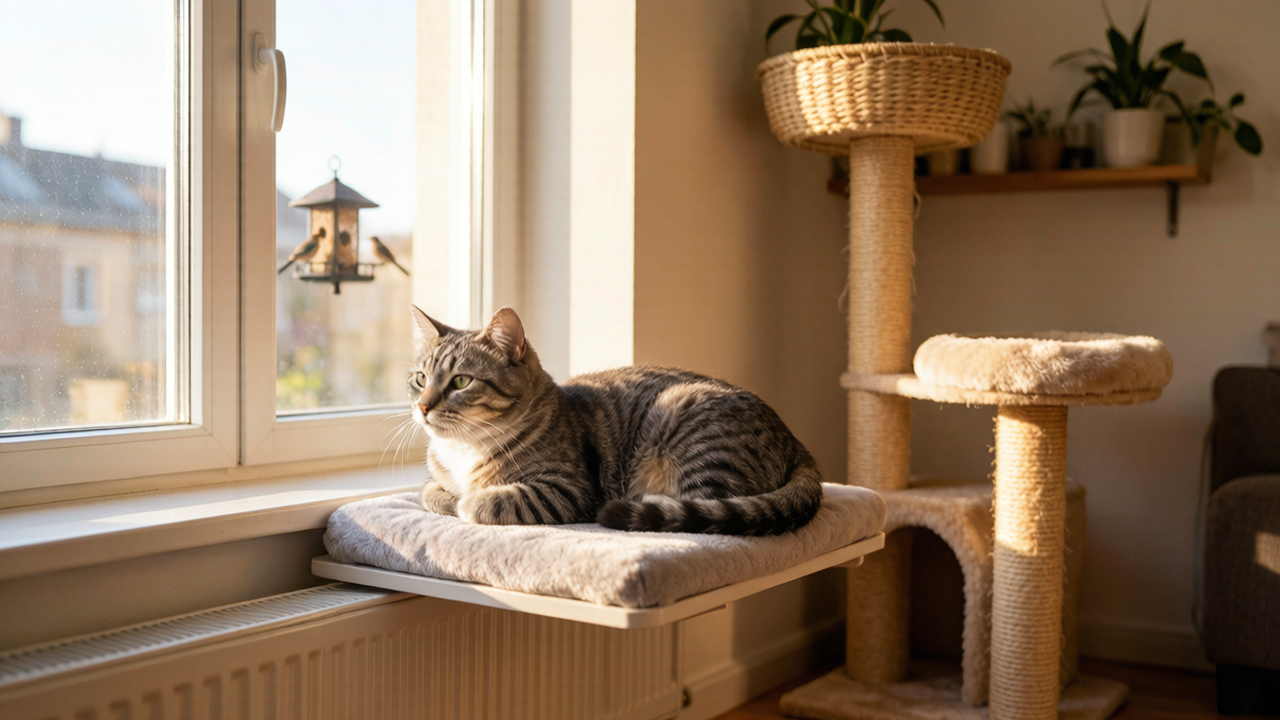
The staring. A cat sitting at the window for hours, completely still, watching birds they can never reach, may look cute. In reality it's the cat equivalent of someone stuck in a room with nothing but a TV playing the same channel on loop.
The food obsession. A cat that goes from a casual eater to one who demands food every time someone enters the kitchen isn't necessarily hungry — they may be bored, and food is the only interesting event in their day.
The ASPCA's guidelines on feline environmental enrichment note that cats who lack appropriate outlets for natural behaviors — hunting, climbing, scratching, hiding, exploring — will often redirect those behaviors into things owners don't want: aggression, overgrooming, destructive scratching, excessive vocalization, and even litter box avoidance. If you're recognizing more than one of those signs in your own cat, that's the pattern.
What Actually Works (and What's a Waste of Money)
For a cat in a small apartment, enrichment isn't optional — it's what keeps a smart animal from going stir-crazy. Here's what earns its keep and what collects dust.
The Game Changers
Puzzle feeders replace the bowl entirely. This is the single biggest shift. Instead of dumping kibble in a bowl twice a day, put it in a puzzle feeder. Suddenly, eating takes 15 minutes of problem-solving instead of 90 seconds of face-in-bowl inhaling. The cat has to bat, paw, and nudge compartments open to get the food. The first week they may give you a betrayed look; by week two they're solving a level-2 puzzle faster than you can set it up.
Start with something like the Catit Senses Food Tree — about $15, with adjustable difficulty. Rotate between a few different puzzles so the cat doesn't memorize one pattern and get bored again. Some days, skip the feeder entirely and scatter kibble across the floor so your cat has to "hunt" for it. A scattered meal can take twenty minutes to clear, and most cats are visibly calmer afterward. That hunt-find-eat sequence is wired deep, and it's easy to underestimate until you watch it play out.
Two 10-minute wand toy sessions, every single day. Waving a toy at the cat for 30 seconds and calling it "playtime" isn't play — it's taunting. Real interactive play mimics prey: the toy darts, hides behind furniture, freezes, then darts again. It moves away from the cat, not toward their face. The cat needs the full stalk-chase-pounce-catch cycle, and they need to actually catch the toy at the end to get the satisfaction of a "kill."
Two weeks of consistent sessions usually makes a visible difference. The 2 AM zoomies fade because your cat is no longer banking a full day of unused hunting energy.
A window perch with an actual bird feeder outside. A $12 suction-cup perch plus a $20 bird feeder on the other side of the glass turns a plain window into your cat's personal IMAX. Many cats will park there for hours, chattering at birds and tracking squirrels. It's passive enrichment — you don't have to do anything once it's set up — and it's often the highest-return change on this entire list.
Vertical space the cat actually uses. A $60 cat tree gets ignored for weeks if it's shoved in a corner facing a wall. Cats want height with a view. Move it next to the window perch and suddenly it's the favorite spot in the apartment. The lesson: a cat tree in a boring location is just expensive furniture; a cat tree where the cat can survey their territory and watch birds is a command center.
Also clear the top of a bookshelf and put a folded towel up there. Cost: zero dollars. Usage: daily. Cats don't care how much you spent.
The Stuff That Didn't Earn Its Keep
Automatic laser toys. Plenty of cats chase one for a couple of minutes, work out that the dot can never be caught, and lose interest permanently. A laser with no physical "catch" at the end leaves cats frustrated rather than satisfied. If you use one, always finish by landing the dot on a real toy or a treat so your cat gets to complete the sequence.
Cat TV on YouTube. Some cats love this; others glance once, yawn, and go back to staring out the actual window. Your mileage may vary.
Expensive "interactive" balls that roll on their own. A fair number of cats are unnerved by the motor noise and give the thing a wide berth. Try a cheap version before spending real money on one.
A Daily Routine That Keeps a Cat Sane
Here's a routine that works. It takes about 30 minutes of active time per day, spread out:
Morning (7:00 AM): 10-minute wand toy session. Make your cat actually work for it — running, jumping, pouncing. Slight panting at the end means you got the intensity right. Then breakfast goes into the puzzle feeder.
Midday: Your cat has the window perch, the cat tree, and a few solo toys left out. Rotate which toys are available every three days so they always feel "new." A toy that's been in a drawer for a week lands very differently than one that's been on the floor for a month.
Evening (6:00 PM): Second 10-minute play session, followed immediately by dinner (also in a puzzle feeder). This mimics the natural hunt-eat-groom-sleep cycle: your cat eats, grooms for ten minutes, then sleeps hard for hours. No 2 AM parkour.
Before bed: Hide a few treats around the apartment — on a shelf, inside a cardboard box, behind a plant. Your cat will find them overnight. It's a small thing, but it gives them something to do while you're asleep.
If Your Cat Could Talk, They'd Probably Say This
The biggest mindset shift for many owners is realizing that indoor cats aren't "low maintenance" — they're low-demand. They won't bark at you or chew your shoes to tell you they're under-stimulated. They'll just quietly lose their minds, and you won't notice until they've licked a bald patch onto their belly or stopped eating or started peeing on your laundry.
You don't need a bigger apartment. You don't need to spend hundreds of dollars. You need to look at your home from four inches off the ground and ask: is there anything interesting happening here, or is this just a comfortable cage?
Start with one puzzle feeder, one window perch, and two consistent play sessions. Give it two weeks. If nothing changes, enrichment probably isn't the issue and it's worth another conversation with your vet — but more often than not, owners discover they had a bored animal on their hands the whole time.
Boredom is one of the most common — and most overlooked — causes of problem behavior in indoor cats. If your cat is showing any of the signs above, start with the basics and watch what changes.
This article is for informational purposes only and is not a substitute for professional veterinary advice, diagnosis, or treatment. Always consult a licensed veterinarian if your pet shows signs of illness, injury, or distress. If you believe your pet is experiencing a medical emergency, contact your veterinarian or the nearest emergency animal hospital immediately.
🐾 Enjoyed This Article?
Save it for later, share with a fellow pet parent, or check out more tips on our homepage!
📩 Never Miss a Tip
Get our best pet care hacks delivered straight to your inbox. No spam, unsubscribe anytime.
Shop pet slow feeder bowl on Amazon & Chewy
Comparing prices before you buy? Check current deals and read reviews from other pet owners.