Early Signs of Arthritis in Dogs: Stairs Refusal, Stiffness and Behavior Changes
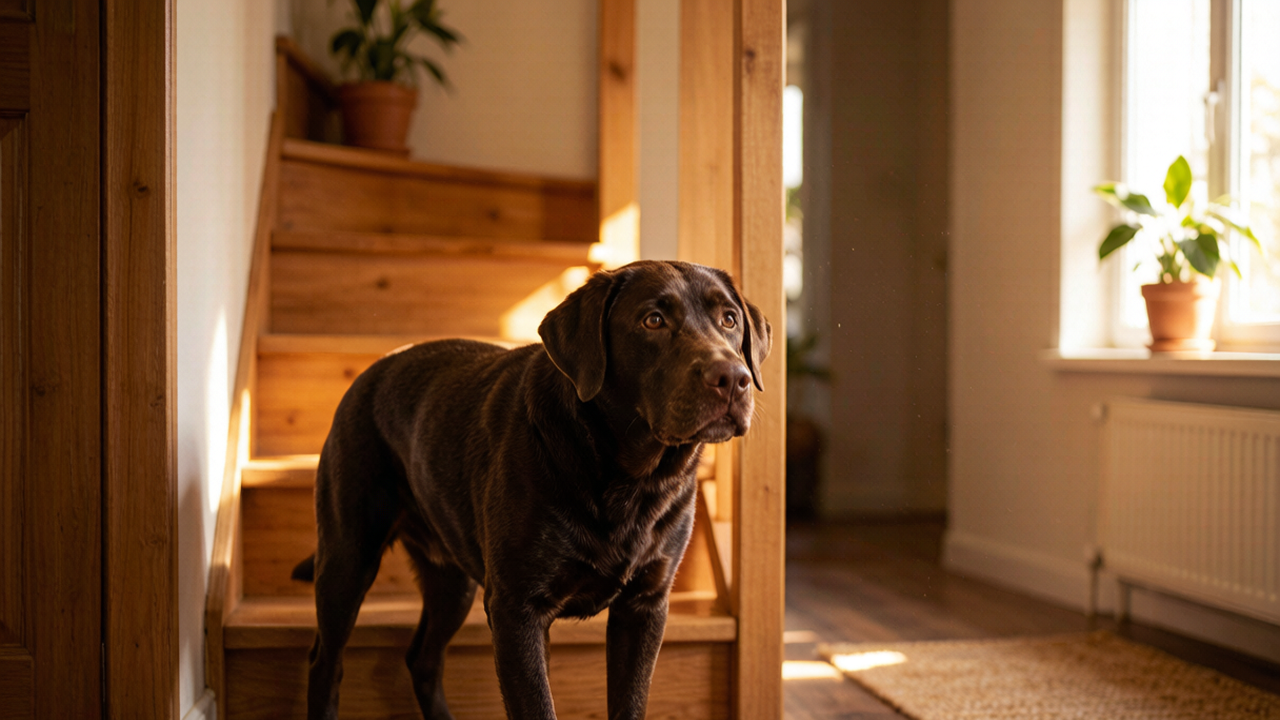
A dog pauses at the bottom of the stairs instead of taking them two at a time. He stops jumping into the back of the car. He's stiff for the first ten minutes after waking up, then seems fine. Almost every owner files this under the same heading: he's getting older.
Veterinarians file it somewhere else. Osteoarthritis is one of the most common chronic conditions in dogs, and it does not wait for a dog's senior years to start — dogs with underlying hip or elbow dysplasia often show the first changes at five or six, while their owners still describe them as young [source].
The gap between "slowing down" and "in pain" is where most early diagnoses are lost.
Why a Limp Is a Late Sign, Not an Early One
Dogs are unusually good at masking joint pain. They shift weight off a sore leg, shorten their stride, and quietly change how they sit and lie down — all long before anything looks obviously wrong to a person watching from the couch. Chronic pain in animals is frequently under-recognised for exactly this reason: the animal adapts faster than the owner notices [source].
By the time there's a visible hitch in the step, cartilage damage is usually well established. The seven changes below are the ones owners most often recognise in hindsight — the "he'd been doing that for a year" list.
1. Hesitation at the Bottom of the Stairs
A dog who used to take stairs two at a time starts pausing at the bottom, taking them one step at a time, or waiting for someone else to go first. Coming down is often worse than going up, because descending loads the front legs and shoulders.
This gets read as laziness. It is usually arithmetic: the dog is calculating whether the movement is worth the discomfort.
2. The Bunny Hop — Both Back Legs Moving as One
Instead of alternating, the hind legs push off together. Owners tend to describe it as their dog's "style." Rehabilitation vets treat it as one of the more reliable early indicators of hip pain: moving both hips through a shorter arc at the same time reduces how far each joint has to flex. It's a compensation pattern, not a quirk [source].
3. Fixated Licking Over a Single Joint
Ten minutes at a time on one carpus ("wrist"), one elbow, one stifle — often leaving a rust-coloured saliva stain in the fur. Dogs commonly lick over painful joints; the warmth and pressure are self-soothing. Repetitive licking confined to one spot is worth an exam rather than a behavioural label.
4. The Personality Change That Gets Called "Mellowing"
This is the sign owners most often miss entirely, because it doesn't look orthopaedic at all. The dog stops initiating tug. He walks away when the leash comes out. He sleeps in a different room instead of pressed against someone on the couch. He gets short-tempered with a puppy or a toddler he previously tolerated.
Behaviour change is one of the recognised indicators of pain in companion animals, and irritability or withdrawal in a previously easy-going dog deserves a physical work-up before a training plan [source]. A dog who has stopped playing may not be mellowing. He may be coping.
5. A Sit That Looks Slightly Off
Watch how the dog sits. Hip or knee pain often produces a "lazy sit" or "puppy sit" — one leg splayed out to the side instead of tucked underneath. In a puppy that's normal flexibility. In an adult dog, and especially when it's always the same side, it usually means the joint isn't being bent all the way.
6. Morning Stiffness That Disappears After Ten Minutes
Stiff and short-strided for the first 10–15 minutes after waking, dramatic stretching, then apparently normal by the time the walk starts. This is the pattern most often dismissed as "he slept funny."
The mechanism is straightforward: inflammatory fluid pools in an arthritic joint during hours of inactivity, and movement redistributes it and warms the joint. Stiffness that resolves with motion and returns after rest is a classic inflammatory pattern — not a sleeping position.
7. Muscle Loss on One Side
Because an arthritic dog shifts weight off the sore limb, the muscle on that side gradually wastes. It is genuinely hard to see day to day, and obvious in a photo from six months earlier [source].
Two-minute home check
- Stand behind your dog and look down at both thighs. Are they the same width?
- Run both hands down both hind legs at once. Does one feel bonier, with less muscle padding over the bone?
- Watch him rise from lying down. Does he push up front-first, or roll onto one hip to get up?
- Time the stiffness after a nap. Under a minute is unremarkable; ten to fifteen minutes is worth mentioning.
None of this diagnoses anything. It gives your vet something specific to work with instead of "he seems slower lately."
Management: What Moves the Needle, Ranked by Evidence
Arthritis doesn't reverse. What changes is how much it limits the dog. Multimodal management — several small interventions stacked together — is the standard approach, and the order below reflects how much benefit each piece usually delivers.
Weight comes first, and it isn't close
Excess body weight increases the mechanical load on inflamed joints and adds inflammatory signalling from fat tissue itself. Weight reduction is the single intervention that most reliably improves comfort and mobility in overweight arthritic dogs, and it costs nothing but discipline at the food bowl. Body condition scoring — feeling the ribs, checking for a waist from above — is more useful than the number on the scale [source].
Controlled movement beats rest
Rest feels protective and usually isn't. Muscle around a joint acts as its shock absorber; when that muscle wastes from inactivity, the joint takes more of the load. What tends to help: slow, sniffy walks on soft or level surfaces, daily and consistent rather than one long weekend hike. What tends to hurt: fetch, frisbee, and anything involving hard stops, twists, or jumping off furniture. Swimming and underwater treadmill work give full range of motion with minimal impact, which is why canine rehabilitation practices lean on them heavily.
Cheap home changes with outsized effects
- Traction. Runners, yoga mats, or rubber-backed rugs along the route from bed to door. Slipping on hardwood is both painful and frightening for a dog with sore hips.
- A ramp instead of a jump. Car loading and unloading is one of the highest-impact movements in a dog's day.
- Raised bowls. Eating from floor level forces an arthritic dog to brace on painful elbows and shoulders.
- Orthopaedic bedding away from drafts. Thin bedding on a hard floor makes morning stiffness worse.
Supplements: modest, slow, and not a substitute
Glucosamine, chondroitin, green-lipped mussel and omega-3 fatty acids are commonly used, and the evidence is mixed rather than absent. Two things are worth understanding before spending money. First, joint supplements are marketed as foods or supplements, not approved drugs, so pre-market proof of effectiveness is not required in the way it is for medications [source]. Second, any effect builds slowly — six to eight weeks is a fair trial period, and the realistic outcome is a mild reduction in stiffness, not a transformation.
Veterinary treatment: ask what's on the menu
This is the part owners most often postpone. Prescription options include NSAIDs licensed specifically for dogs, injectable polysulfated glycosaminoglycans that target joint cartilage rather than pain, newer injectable monoclonal antibody treatments for canine osteoarthritis pain, and formal rehabilitation referral. Human painkillers are not a bridge option — ibuprofen, naproxen and paracetamol are toxic to dogs, sometimes at a single tablet [source].
⚠️ Don't self-medicate joint pain. Never give a dog a human anti-inflammatory, and never split a prescription between two dogs. Dosing is weight-specific, and NSAIDs licensed for dogs still require baseline bloodwork and monitoring in most cases.
Questions Owners Ask Most Often
Is my dog too young for arthritis? Probably not. Developmental joint disease — hip and elbow dysplasia, cruciate injury, patellar problems — produces secondary arthritis in young and middle-aged dogs. Age is a risk factor, not a prerequisite.
Should I stop walking him? No, but change the walk. Shorter, more frequent, on softer ground, with sniffing instead of sprinting.
Does cold weather really make it worse? Many owners report it does, and it's consistent with what's known about stiffness and inactivity: dogs move less in cold weather, and less movement means more stiffness on rising.
How fast should I expect improvement after a diagnosis? Pain control often shows within days. Weight loss and muscle rebuilding are measured in months. Owners who judge the whole plan on week one usually abandon the parts that were going to help most.
When to Book the Appointment
Two or more of the seven signs above, persisting for more than two weeks, is enough reason to have a dog examined — even a young one, even without a limp. Bring video. A thirty-second clip of the dog rising from his bed, walking away from the camera, and climbing three stairs gives a vet more information than any description, because dogs frequently move differently in a clinic than they do at home.
Escalate faster if any of the following appear: sudden non-weight-bearing lameness, a joint that is hot or swollen, yelping when touched, a limp that appeared overnight after exercise, or a dog who stops eating. Those patterns point at injury or infection rather than gradual osteoarthritis, and they are not a "wait and see" situation [source].
The Short Version
Arthritis in dogs is progressive, common, and manageable — and the window where management does the most good closes before the limp arrives. Dogs diagnosed early, kept lean, moved consistently, and given appropriate pain control frequently go on to climb stairs, load into cars, and play well into their senior years. That outcome depends far more on how early somebody notices the small stuff than on any single supplement, injection, or product.
If a dog has been "slowing down" for a year, the more useful question is what he stopped doing, and when.
This article is for informational purposes only and is not a substitute for professional veterinary advice, diagnosis, or treatment. Always consult a licensed veterinarian if your pet shows signs of illness, injury, or distress. If you believe your pet is experiencing a medical emergency, contact your veterinarian or the nearest emergency animal hospital immediately.
🐾 Enjoyed This Article?
Save it for later, share with a fellow pet parent, or check out more tips on our homepage!
📩 Never Miss a Tip
Get our best pet care hacks delivered straight to your inbox. No spam, unsubscribe anytime.
Shop dog supplies on Amazon & Chewy
Comparing prices before you buy? Check current deals and read reviews from other pet owners.