Why Does My Cat Throw Up Right After Eating?
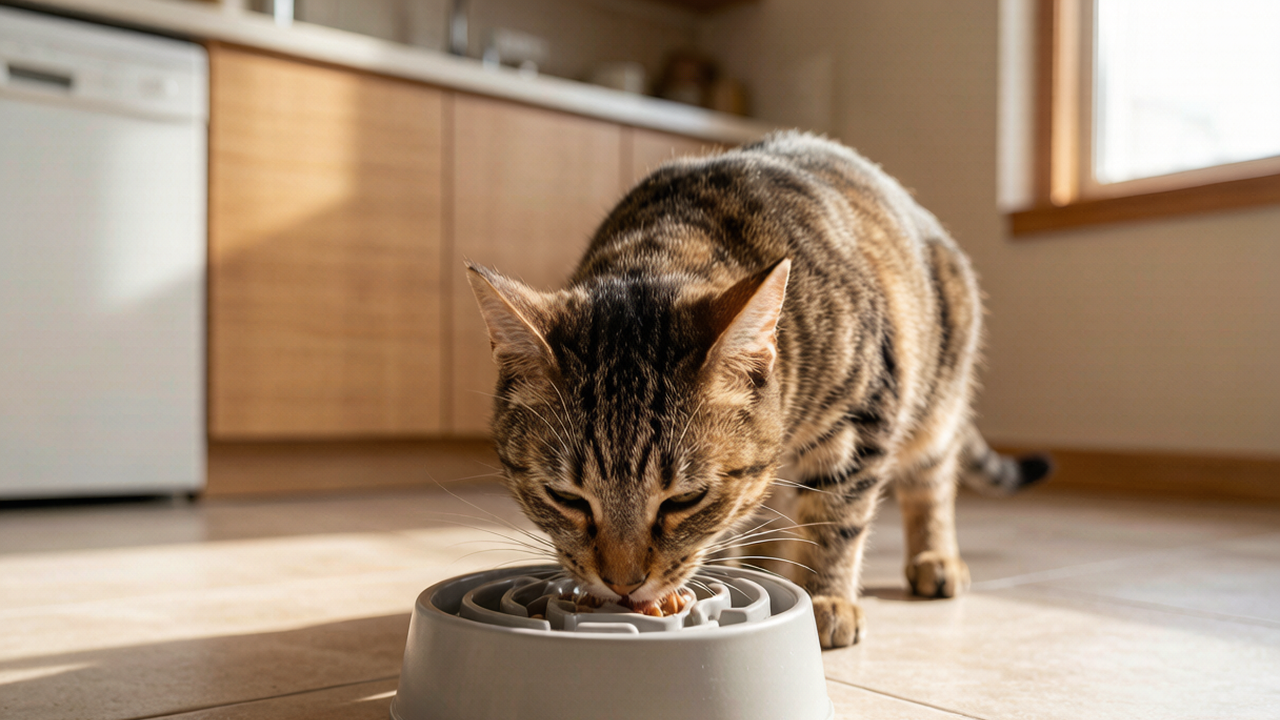
There's a special kind of dread that comes with hearing your cat start heaving five minutes after breakfast. You know the sound — that wet, rhythmic hurk-hurk-hurk that means whatever just went down is about to come back up. And when it does, you can see every single piece of kibble, still perfectly intact, sitting in a puddle on your rug.
The first few times this happens, it's natural to panic. Is it the food? Is the cat sick? Did they eat something poisonous? An emergency vet visit often ends with one question: "Does your cat eat really fast?"
For a speed eater, a bowl can be emptied in under 60 seconds every time — sometimes under 30 when they're excited.
If the answer is yes, the likely diagnosis is what veterinarians call "scarf-and-barf."
It's one of the most common — and most fixable — feline feeding problems out there.
The Speed-Eating Phenomenon Nobody Warns You About
Here's what's happening inside your cat when they Hoover their food in 30 seconds flat. The stomach has a physical limit. When a cat swallows kibble whole — and they do, because cat teeth are designed for tearing meat, not chewing dry pellets — those hard pieces sit in the stomach and absorb liquid. They expand. If your cat ate too much too fast, the stomach stretches beyond what's comfortable, and the brain sends a one-way signal: evacuate immediately.
The food comes back up before it's even started digesting. That's why you see whole kibble pieces in the vomit. It never made it past the stomach.
This is different from vomiting that happens hours after eating, or vomiting bile on an empty stomach, or vomiting that involves hairballs. Those are separate issues. The "ate-too-fast" vomit is distinctive — it happens within 5 to 20 minutes of a meal, the food looks barely touched by digestion, and your cat usually acts completely normal right afterward, like nothing happened.
A cat that scarf-and-barfs will often throw up, then walk straight back to the empty bowl and meow for more — unfazed, as if nothing happened.
Three Solutions to Try (And Which Ones Actually Work)
Here are the options worth testing, from simplest to most reliable.
Solution 1: The Golf Ball Trick
You put a couple of clean golf balls in the food bowl so the cat has to eat around them. It forces them to slow down because they can't just shovel food in mouthfuls.
Result: It works for about two days. Then many cats figure out they can use a paw to hook the golf balls out of the bowl and send them skittering across the floor. Clever, but not helpful.
Verdict: Works for cats who aren't genius-level problem solvers. If your cat is average intelligence, try it. If your cat opens cabinets, skip this one.
Solution 2: Spreading Kibble on a Flat Plate
Instead of a bowl, pour the food onto a large dinner plate, spreading it into a single layer. The cat has to pick up one or two pieces at a time instead of grabbing mouthfuls.
Result: This actually helps — a lot. Eating time goes from roughly 45 seconds to about 3 minutes, and the vomiting drops from once a day to maybe twice a week.
Verdict: Good quick fix. Costs nothing. But it may not completely solve the problem.
Solution 3: The Slow Feeder Bowl (The Actual Winner)
A slow feeder bowl with a maze-like pattern of ridges and spirals is the most reliable fix. These bowls are designed so kibble settles into narrow channels, and the cat has to work a paw or tongue into each groove to retrieve one piece at a time.
Result: Game changer. Eating time jumps to 8 to 10 minutes. The vomiting usually stops completely within the first week. Some cats are annoyed for the first couple of days but adjust quickly.
Verdict: If your cat is a speed eater, just buy one. They cost between $8 and $20 and solve the problem for most cats.
Here's what to look for in a slow feeder: shallow channels (not deep crevices that frustrate your cat), a non-slip bottom so it doesn't slide across the floor, and dishwasher-safe material because dried cat food residue is disgusting to scrub by hand.
Bonus: Wet Food on a Lick Mat
If you feed wet food and your cat still eats too fast, try smearing the pâté onto a lick mat — those textured silicone mats with little ridges. It takes a cat 5 to 10 minutes to lick all the food out of the grooves, and it doubles as mental enrichment. Doing this once a day as a treat works well, and most cats love it.
Small Meals, Big Difference
One thing owners often miss: meal size matters as much as eating speed. A cat's stomach is roughly the size of a ping-pong ball when empty. That's tiny. If you're dumping a half-cup of kibble in the bowl twice a day, you're asking that ping-pong ball to handle far more than it comfortably can.
Switch from two large meals to four small ones. An automatic feeder makes this painless — it drops a measured portion at scheduled times. The cat never gets so hungry that they inhale their food.
For multi-cat households, this also solves a secondary problem: competition. If one cat eats fast because they're worried another cat will steal their food, separating their feeding stations is non-negotiable. Feed them in different rooms or at different heights (cats feel safer eating from elevated surfaces). Many owners with several cats feed them in separate rooms with the doors closed — the "scarf-and-barf" cat often stops vomiting within days.
When It's Not Just Eating Too Fast
One important caveat: not all post-meal vomiting is "ate too fast." If your cat's vomiting is accompanied by any of these, get to a vet:
- Weight loss (even a few ounces)
- Lethargy or hiding more than usual
- Vomit that contains blood or looks like coffee grounds
- Changes in appetite — eating less or not at all
- Vomiting that happens hours after eating (not minutes)
- Diarrhea alongside the vomiting
Veterinarians note that food allergies, inflammatory bowel disease, and hyperthyroidism can all cause vomiting that looks similar to the "ate too fast" type. The difference is pattern and frequency. If you've tried the solutions above for two weeks and your cat is still throwing up regularly, the problem probably isn't speed — it's medical.
Key Takeaways
A $12 slow feeder bowl and an automatic feeder can replace a costly emergency vet visit for this particular problem. Start with the simplest fix and work up from there.
The vomiting typically stops within a week or two once eating slows down. Most cats settle into the new routine without complaint.
If your cat is a scarf-and-barfer, start with a flat plate tonight. If that helps but doesn't fix it, get a slow feeder. And if nothing changes after two weeks, book that vet appointment. A cat's stomach is the size of a ping-pong ball — treat it accordingly.
If your cat inhales food like it's their last meal, the steps above are the place to start. Share this with another cat owner who might be dealing with the same rug-side cleanups.
🐾 Enjoyed This Article?
Save it for later, share with a fellow pet parent, or check out more tips on our homepage!
Shop cat slow feeder bowl on Amazon & Chewy
Comparing prices before you buy? Check current deals and read reviews from other pet owners.