How to Bathe a Cat Without Getting Shredded: A Step-by-Step Guide
A cat that gets into a jar of coconut oil ends up on the kitchen counter covered head to shoulders in greasy white goop, and the mess is unambiguously your problem. Towels and wipes don't work — the oil soaks down to the skin and the fur clumps into stiff, shiny spikes. That's when a bath stops being optional.
Calm sink-baths in lavender-scented shampoo are YouTube fiction. In reality a first attempt often ends with a bathroom that looks like a crime scene, a shredded towel, and a soaking-wet, deeply offended cat hiding under the bed for three hours. It gets better with preparation — here's how.
The second attempt goes better with the right setup — not perfect, but manageable. Here's what to do differently.
First: Do You Actually Need to Bathe Your Cat?
Cats are obsessive self-groomers. A healthy cat spends 30-50% of their waking hours cleaning themselves, and their tongue is basically a built-in brush covered in tiny backward-facing barbs called papillae. In most cases, they don't need your help.
There are exactly five scenarios where bathing a cat makes sense:
- They got into something toxic or sticky. Motor oil, paint, sap, grease, anything they shouldn't be licking off their own fur.
- Flea infestation. A bath with cat-safe flea shampoo can be faster and more thorough than spot treatments alone, especially for kittens too young for chemical preventatives.
- Skin conditions requiring medicated shampoo. Ringworm, yeast infections, or severe dandruff where your vet has prescribed a specific shampoo.
- They're elderly, obese, or arthritic and can no longer reach certain areas to groom themselves.
- They're a breed that needs it. Hairless cats (Sphynx) need weekly baths because their skin oils have no fur to absorb into. Some long-haired breeds benefit from occasional baths to prevent matting.
If your cat doesn't fall into one of these buckets, skip the bath. Really. You're not doing them a favor, and you're setting yourself up for a bad time. Spot-cleaning with pet wipes or a damp washcloth handles 90% of "my cat is kinda dirty" situations.
What to Buy (and What's Actually Useful)
Before the bath, stock up on the right supplies rather than panic-buying everything. Here's what's actually worth having:
Actually useful:
- Cat-specific shampoo ($8-12). Do not use human shampoo, dish soap, or dog shampoo on a cat. Their skin pH is different (more alkaline than ours), and ingredients that are fine for us can be harsh on them. A tearless, lightly scented option such as Burt's Bees for Cats works well and avoids the heavy fragrance cats hate.
- A non-slip mat ($6). This matters more than anything else. A terrified cat on a slippery tub surface has zero traction and maximum panic. Cut a cheap yoga mat to fit the bottom of the tub. It gives the cat something to grip, taking it from "frantic scrabbling" to "miserable but stationary" — a real win.
- A detachable shower head or a large plastic cup ($0-5). You need controlled water flow. A fixed shower head is too intense and sprays everywhere. A 32-ounce plastic cup from the kitchen is wide enough to scoop water quickly but easy to aim.
- Multiple old towels. Not one. Not two. At least four. You'll use them for the floor, for drying, for wrapping the cat like a burrito, and for the inevitable escape-and-drip-on-the-couch moment.
Not useful:
- A "cat bathing bag" ($15). It's basically a mesh straightjacket. Many cats go from nervous to full panic the second you try to zip them into it. Some tolerate them, but for most it makes everything worse.
- A rubber grooming glove. Useless when wet. Just use your hands.
- Special "pet dryer." A regular towel and a warm (not hot) room works fine. Most cats hate a noisy dryer pointed at them, and it can trigger fight-or-flight.
The Step-by-Step Process That (Mostly) Worked
Phase 1: Prep Before You Even Look at the Cat
Learn this the hard way if you must: once the cat is wet, you cannot leave to grab the shampoo you forgot, and you cannot answer the door. You are committed. Before bringing the cat into the bathroom, set up:
- Non-slip mat in the tub
- Shampoo bottle open and within arm's reach
- Cup filled with lukewarm water (test it on your inner wrist — should feel barely warm, around 100-102°F)
- Four towels laid out in order: one on the floor outside the tub, two stacked next to the tub for drying, and one more as backup
- Door closed, bathroom pre-warmed (run the shower on hot for 2 minutes to steam up the room, then switch to lukewarm)
The water temperature matters more than you'd think. Cats run hot — their normal body temp is 100.5-102.5°F — and water that feels "warm" to us can feel cold to them. Too hot and you'll scald them. Aim for baby-bottle temperature.
Phase 2: Getting Her In Without a Fight
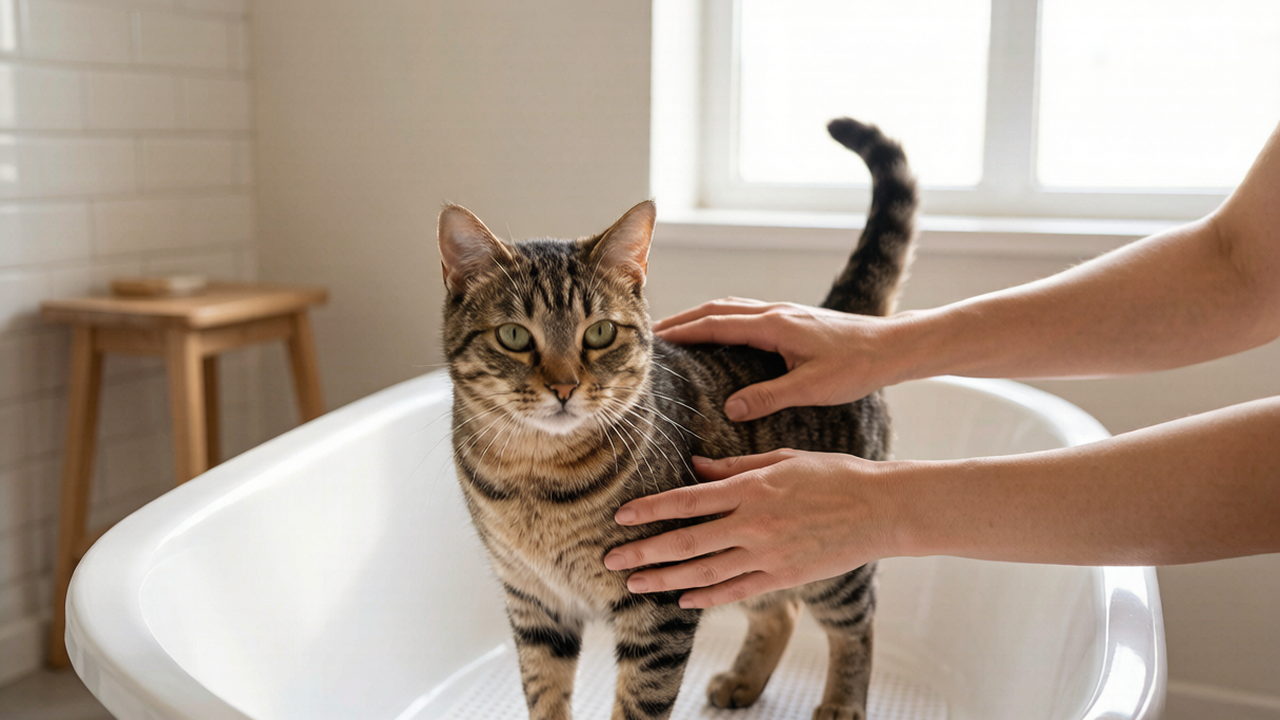
Carrying a cat straight into the tub invites panic before you even start. Instead, carry the cat into the bathroom first and sit on the floor together for a few minutes. Give a treat. Let it sniff the setup. Then pick it up and lower it into the dry tub, with the mat already in place, and give another treat while it stands there. Only then start the water.
Fill the tub with 2-3 inches of water at most. Cats panic in deep water. You want enough to scoop and pour, not enough for them to feel like they're drowning.
Don't hold the cat down — it triggers their "I'm being restrained by a predator" instinct and makes everything worse. Let it stand. Keep one hand lightly on the shoulders, not pushing, just present, and it will usually stay put once it can grip the mat and senses you aren't forcing it.
Phase 3: The Actual Washing
Work from neck to tail, never head to toe. If water or shampoo gets in their ears, eyes, or nose, you've lost them. Wet the body by pouring cupfuls of water along the spine, avoiding the head completely. Then work in a quarter-sized amount of shampoo, lathering gently with the direction of the fur — rubbing against the grain pulls and hurts.
Spend the most time on the areas you actually need to clean. For a coconut-oil disaster, that's the neck, chest, and shoulders. The back half is usually fine, so barely touch it. The less time you spend messing with areas that don't need it, the better.
Rinsing is where most people mess up. Shampoo residue is itchy and cats will lick it off, ingesting whatever's left. Rinse each section three times — pour water, massage gently to work out soap, pour more water, repeat — until the water running off is completely clear. This takes longer than you expect; budget at least 5 minutes just for rinsing.
For the face and head: don't pour water directly. Use a damp washcloth, wrung out so it's not dripping, and wipe carefully around the ears, chin, and cheeks. Most cats tolerate this surprisingly well, probably because it feels more like being groomed than being bathed.
Phase 4: The Exit Strategy
The second the rinsing is done, wrap the cat in a towel — immediately, before they shake. Cats can hold a surprising amount of water in their fur, and a single full-body shake can redecorate your bathroom in seconds.
Wrap the cat like a burrito (towel under it, fold sides in, then fold the front over) and hold it against your chest for about two minutes. This does two things: it absorbs a ton of water and it calms the cat. The pressure of being wrapped is comforting to cats — the same principle as a thunder shirt.
Then swap to a dry towel and pat (never rub) the fur to soak up more moisture. Rubbing creates tangles and static, and cats hate both.
Finally, put the cat in a warm, draft-free room with the door closed and let it finish drying on its own. It will groom obsessively for about an hour — that's normal, as it redistributes natural oils and restores the fur. By the time you let it out, it's mostly dry and only mildly resentful.
What NOT to Do
- Don't use a blow dryer unless your cat has been trained to tolerate it since kittenhood. The noise alone will send most cats into fight-or-flight.
- Don't fill the tub more than 3-4 inches. Cats are not dogs. They don't want to swim.
- Don't wash their head with running water. Face and ears get a damp cloth only.
- Don't bathe a cat more than once every 4-6 weeks unless medically necessary. Over-bathing strips their natural oils and leads to dry, irritated skin.
- Don't use dog flea shampoo on cats. Many contain permethrin, which is highly toxic to cats and can cause tremors, seizures, and death. Always check that any product is specifically labeled for cats.
How Long It Takes a Cat to Recover
After a disastrous first bath: expect the cat under the bed for a few hours, then a slow blink of contempt on the way to the food bowl like nothing happened. Check your towels for claw-shaped souvenirs.
After an improved second bath: 45 minutes of self-grooming, then the cat emerges, sits just out of reach, and pointedly ignores you while purring. That's progress.
The lesson: the difference between a traumatic bath and a tolerable one is 90% preparation and 10% technique. Winging it leads to disaster; setting up carefully changes the cat's whole experience.
Most cats never enjoy a bath, but a calm, well-prepared session keeps it safe and low-stress for both of you.
This article is for informational purposes only and is not a substitute for professional veterinary advice, diagnosis, or treatment. Always consult a licensed veterinarian if your pet shows signs of illness, injury, or distress. If you believe your pet is experiencing a medical emergency, contact your veterinarian or the nearest emergency animal hospital immediately.
🐾 Enjoyed This Article?
Save it for later, share with a fellow pet parent, or check out more tips on our homepage!
📩 Never Miss a Tip
Get our best pet care hacks delivered straight to your inbox. No spam, unsubscribe anytime.
Shop cat supplies on Amazon & Chewy
Comparing prices before you buy? Check current deals and read reviews from other pet owners.