Why Is My Cat Hiding All Day? How I Learned to Read the Silent Signs
Why Is My Cat Hiding All Day? How I Learned to Read the Silent Signs
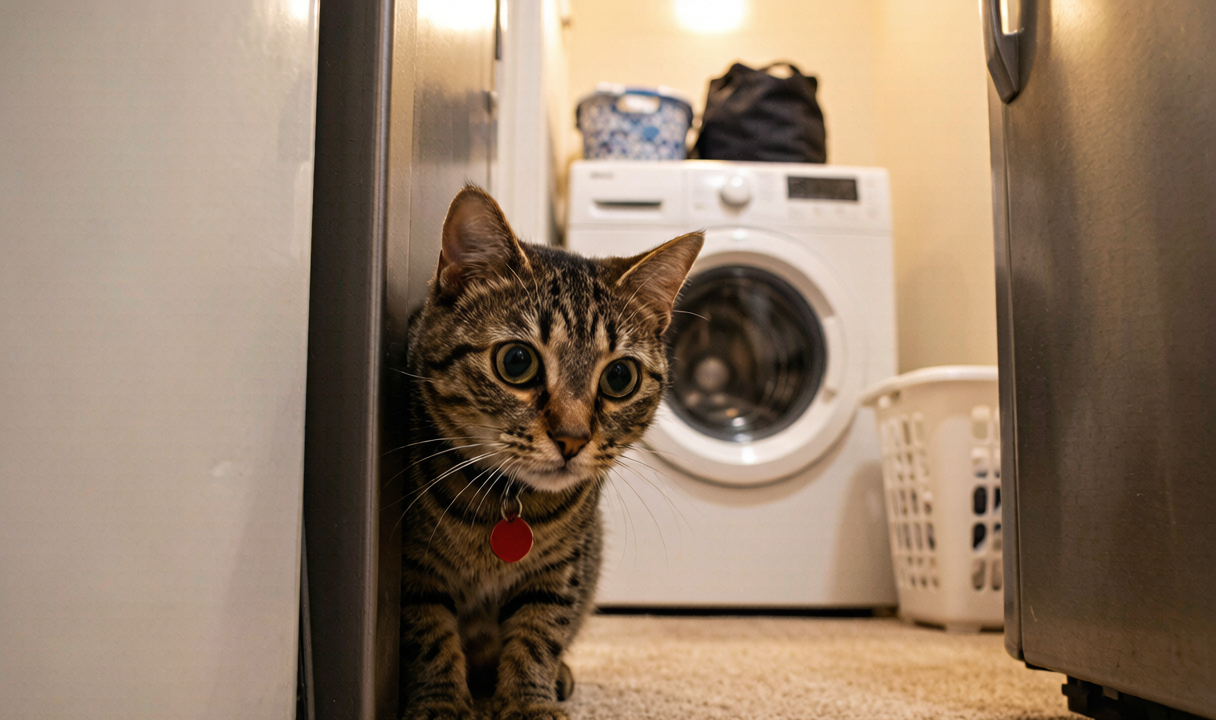
Our cat, Mochi, disappeared for an entire afternoon, and I didn't even notice at first. I was working from home, deep in a spreadsheet, and it took me until dinner time to realize I hadn't seen her since breakfast. When I finally found her, she was wedged behind the washing machine in a gap so narrow I couldn't believe she'd fit. She looked up at me with those wide, flat eyes — not scared, exactly, but definitely not relaxed. And I felt that familiar sick feeling: *is she sick? Is something wrong? Did I miss something?*
If your cat has started hiding more than usual, you're probably in the same spiral of worry. Cats are already secretive by nature, so when they retreat even further, it's hard to tell whether it's "just a cat being a cat" or something you need to act on. I spent months learning to read Mochi's hiding patterns, and I want to share what I figured out — because most of what I found online was either too vague or too alarmist.
First: Some Hiding Is Totally Normal
Let me start with the reassuring part. Cats hide. That's just how they're built. In the wild, small predators spend a huge chunk of their time in enclosed spaces — it's how they stay safe from bigger predators and conserve energy between hunts. So when your cat disappears under the bed for a few hours, that's not automatically a crisis.
Mochi has three hiding spots she rotates through depending on her mood: behind the washing machine when she wants total darkness and isolation, inside the closet on a specific sweater when she wants warmth and softness, and under the couch when she wants to be *near* us but not *with* us. These are her normal zones. I know them because I've watched her patterns over months.
The key question isn't "is my cat hiding?" — it's "is this hiding *different* from their normal pattern?"
Here's what I mean: if your cat usually spends the morning under the bed and comes out for dinner, that's their routine. But if they suddenly start staying under the bed through dinner and beyond, that's a change worth investigating.
When Hiding Signals Stress
The first time Mochi's hiding really worried me was after we moved apartments. She went from her normal three-hour disappearances to spending literally 18 hours a day behind the washing machine. She wouldn't come out for food unless I placed it right at the gap's entrance. She wouldn't use her litter box — I found accidents in corners of rooms she'd never peed in before.
This was stress hiding, and it's the most common reason cats retreat beyond their normal patterns. The triggers can be:
- **Environmental changes** — moving, rearranging furniture, new people in the house, construction noise outside
- **New pets** — we briefly fostered a dog, and Mochi went into hiding mode for a solid week
- **Schedule changes** — if you suddenly start working late and your cat's evening routine shifts, that can trigger withdrawal
- **Loud events** — parties, fireworks (we already covered that in another article), even a loud TV session can push a sensitive cat underground
What worked for Mochi during the move: I created a "safe room" — our bedroom, with her food, water, litter box, and favorite blanket all in one spot. No other animals, no loud noises, just her and her stuff. I sat in there reading for an hour each evening so she'd have my company without pressure. She came out from behind the washing machine on day four, and by day seven she was exploring the rest of the apartment again. It wasn't instant, but it was steady.
When Hiding Signals Illness (This Is the Scary One)
Here's the part that most casual articles gloss over: cats hide when they're sick. Not just "a little under the weather" sick — genuinely unwell. This is instinct. A sick animal in the wild is vulnerable, so they conceal themselves. It's not dramatic or obvious. It's quiet and easy to miss.
The specific signs that told me Mochi's hiding was illness-related, not stress:
- **She stopped coming out for food entirely.** This was the big one. A stressed cat will usually eat if you bring food close. A sick cat often won't eat at all.
- **Her posture in the hiding spot was different.** Instead of curling up loosely (relaxed hiding), she was crouched tight with her head pressed against the wall. This is what vets call a "hunched posture" and it's a pain indicator.
- **She didn't groom.** Mochi is usually meticulous — I'd see her licking her fur for 20-minute sessions. When she was sick, she looked dull and unkempt within two days.
- **Her eyes changed.** Not just "wide" — the pupils were dilated even in dim light, and she had that half-closed, squinting look that indicates discomfort.
When I saw these signs together, I took her to the vet within 24 hours. Turned out she had a urinary tract infection — something that's common in cats and can become dangerous fast if untreated. The vet said the hiding was actually helpful because it told me something was off, even though Mochi wasn't crying or acting dramatic. Cats don't announce their pain. They whisper it through behavior changes.
Other illness-related hiding patterns to watch for:
- **Hiding near water but not drinking** — kidney issues, diabetes
- **Hiding in cool spots** (tile floors, near AC vents) — possible fever or overheating
- **Hiding and vocalizing quietly** — dental pain, abdominal pain
- **Repeated hiding in a *new* spot** — if your cat abandons their usual hiding places and picks somewhere unfamiliar, that's a change worth noting
The Difference Between "I Need Space" and "I Need Help"
This is the distinction that took me the longest to learn, and I think it's the most valuable thing I can share.
"I need space" hiding looks like this:
- Cat emerges voluntarily for meals, play, or affection
- Body is relaxed when found (loose curl, soft eyes, slow blink)
- Cat returns to the same familiar spots
- Behavior is consistent day to day — same pattern, same duration
"I need help" hiding looks like this:
- Cat doesn't emerge for food or interaction
- Body is tense (hunched, pressed against surfaces, stiff)
- Cat chooses new hiding locations or abandons old ones
- Behavior escalates — hiding gets longer and more frequent over days
- There are other subtle changes: decreased grooming, different vocalizations, changed litter box habits
When Mochi was just stressed from the move, she'd come out for her evening can of wet food and then go back to her spot. She was still engaged with the household, just from a distance. When she was sick with the UTI, she didn't come out at all — not for food, not for her favorite toy, not for me. That total withdrawal was the red flag.
What I Do Now When Mochi Hides
After going through both the stress episode and the illness episode, I've built a simple monitoring routine that takes about five minutes a day:
- 1. **Check her hiding spots morning and evening.** I don't drag her out — I just look to see if she's there and note her posture.
- 2. **Track her food intake.** I weigh her dry food bowl each morning and evening. If it hasn't changed by evening, that's flagged.
- 3. **Note grooming status.** A quick visual check — is her coat smooth or dull? Are there any mats?
- 4. **Watch her litter box.** Frequency, amount, and location. Accidents outside the box are always noted.
This isn't obsessive monitoring — it's the same kind of awareness you develop for any family member. When my kid skips dinner, I notice. When my cat skips dinner, I notice now too.
One More Thing: Don't Drag Them Out
The biggest mistake I made early on was physically pulling Mochi out of her hiding spots when I was worried. It felt like the right thing — I wanted to check on her, see if she was okay, comfort her. But from her perspective, I was a giant hand reaching into her safe space and removing her against her will. That made her hide *more*, not less.
Instead, I learned to sit near her hiding spot and talk softly. Read a book out loud. Sometimes I'd put a treat just at the edge of her space, not forcing her to come all the way out but encouraging a small step. When she eventually emerged on her own terms, I'd give her calm affection — a slow blink, a gentle stroke, nothing over the top.
Cats need to feel that their hiding spots are truly theirs. If you violate that, you remove one of their primary coping mechanisms. Even when I was worried sick about her UTI, I didn't drag her to the vet carrier — I lured her with food and let her walk in herself. The vet actually commented that she was less stressed than most cats they see, and I think it's because she still had agency in the process.
Has your cat ever gone into hiding mode that worried you? What did you do, and how long did it take them to come back around? Share your experience — I read every comment, and someone else going through the same thing might really need your insight.
🐾 Enjoyed This Article?
Save it for later, share with a fellow pet parent, or check out more tips on our homepage!